The Big Game: Worst to First – Culture, Talent, Champions | Work 20XX Ep57


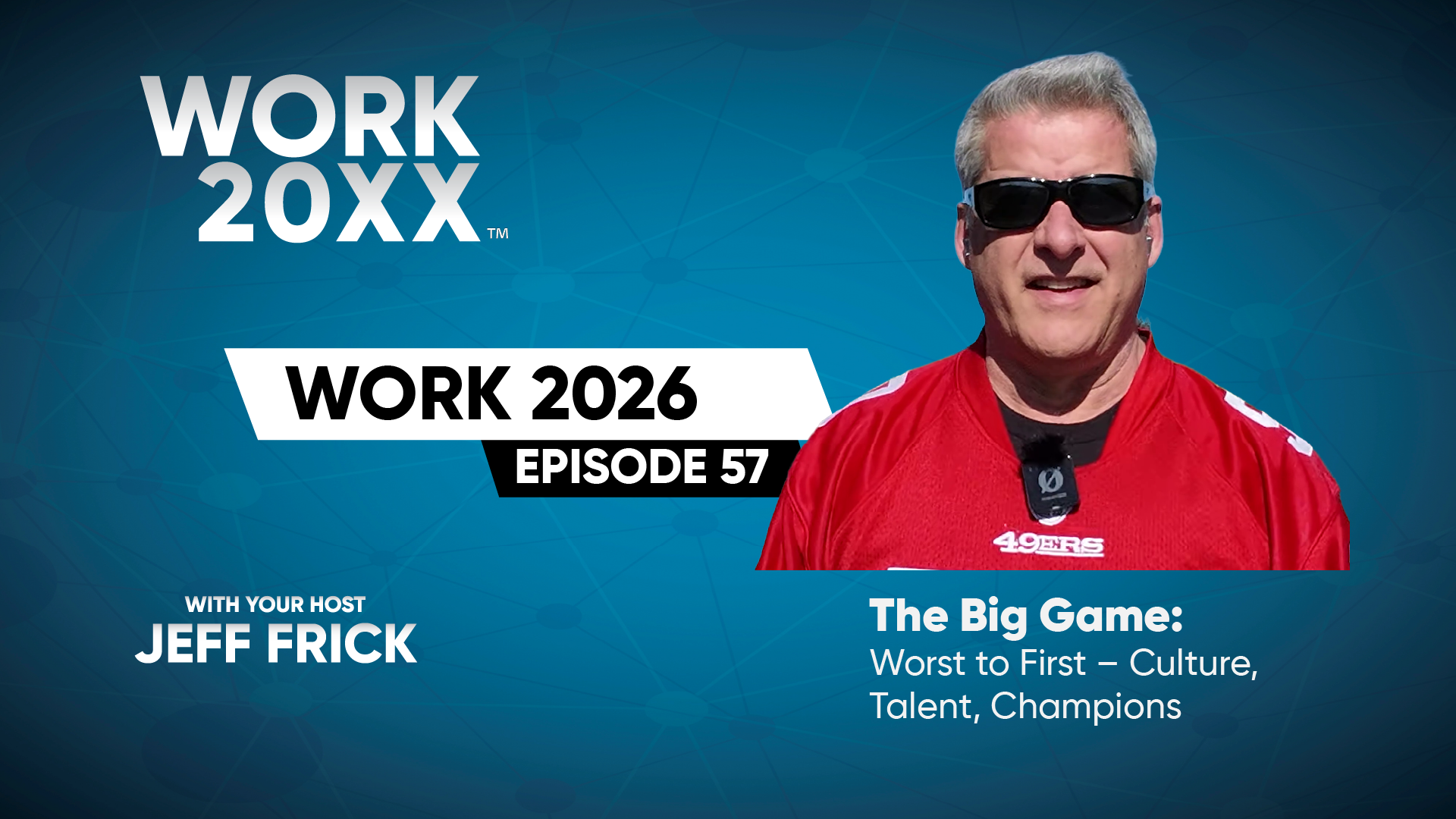
The Big Game: Worst to First – Culture, Talent, Champions | Work 20XX Ep57
"It's about creating an environment that enables people to do the best work of their lives. Finding the best talent, empowering them, making the changes you need." - Jeff Frick
Indiana won a national championship with 7 blue-chip recruits. Their opponents had 110+. What Curt Cignetti's talent strategy teaches us about the future of work.
Episode Transcript
The Big Game: Worst to First – Culture, Talent, Champions | Work 20XX with Jeff Frick Ep57
English Transcript
© Copyright 2026 Menlo Creek Media, LLC, All Rights Reserved
—
Cold Open
3, 2, 1
[Drone engines whining]
Jeff Frick:
All right, I think we're recording. Hello, everybody. Well, today is the day of the big game. We're not supposed to use it's other name because some people get upset if we use that name. But, like a lot of people, I decided to go ahead and invest in the business and get a Super Bowl commercial as what seems to be the trend. Everybody's releasing their commercials early. So I'm going to release my commercial early.
What I want to talk about in my commercial is what the future of work is. What is the future of work? The future of work is not hybrid. It's not return to office. It's none of that. It's how do you put together the best team and equip them to win today?
So Curt Cignetti comes into the University of Indiana, historically the worst football program in the history of the Big Ten. And in his second season goes 16-0 and wins a National Championship. This is crazy. So what did he do? He adapted to the new environment.
Here's what the old environment looks like. The old environment was defined by your blue chippers. Your blue chippers. That means a high school football player that was rated by a service to be either a four star or a five star athlete on a five point scale. Indiana's roster had less than 10% blue chippers. Less than 10%.
And in going 16-0 this season they beat Penn State. Penn State's rosters is over 50% blue chippers. They beat Miami for the National Championship. Also over 50% blue chippers. They beat Oregon. Oregon, two thirds of Oregon's roster is blue chippers. They beat Coach Cignetti's coaching alma mater, Alabama, and also Ohio State that have over 70% blue chip roster, 70%. Cignetti had seven players, less than 10%.
So what's the lesson? What's the future of work? Identify talent. Put it to work. Enable it to succeed. Because the other thing as we watch the big game today is to think about the NFL. The NFL has basically unlimited resources to evaluate talent. They have hours and hours of tape of the subjects doing the exact skill and behavior for which they want to hire them, and still they blow it.
The Niners traded up, they gave up like three first round picks to get Trey Lance as the third pick in the draft. And on that very same draft, the very last pick of the draft. Mr. Irrelevant. They got this kid named Brock Purdy. Guess who signed a $265 million deal and has started in two Super Bowls. Not Trey Lance. So it's really hard to evaluate talent.
If you look at Coach Cignetti, his whole history of coaching is coming up through recruiting. So he's spent the time, he knows how to get talent. And you think okay, well, the transfer portal came. Did Coach Cignetti just go out and get a bunch of Blue Star, or excuse me, blue chip transfers from other schools that weren't getting playing time? No, he got kids he knew were good football players that were below the radar. He didn't follow the herd. And then he created a culture of success right from the beginning. I think they lost three games in their first year and went undefeated in their second year.
So the future of work is about putting together the right team and giving them the tools to succeed. Which more and more are basically training them and enabling them to do to work with AI tools. Look, what's happening in software coding. You have to empower your people to use these new tools. You have to invest in the training so they can use these new tools. A lot of that's group training. People learn better in groups. So that's what it's all about.
I hope you enjoyed my Super Bowl commercial. I'll just beep that out. I hope everybody has a great day. I hope it's a great game. My team's not in it this year. And most importantly, that everybody stay safe because it is a dangerous sport. Anyway, thanks for watching. Have a great day. Thanks for listening on the podcast. See you later. Jeff Frick checking out.
The Big Game: Worst to First – Culture, Talent, Champions | Work 20XX with Jeff Frick Ep57
English Transcript
© Copyright 2026 Menlo Creek Media, LLC, All Rights Reserved
The Big Game: Worst to First – Culture, Talent, Champions | Work 20XX with Jeff Frick Ep57
per Claude, (that does not include the 16-0 year in it's native learning data timeset)
TALENT EVALUATION IN FOOTBALL: WHY IT'S SO HARD
The NFL Draft: A Case Study in Evaluation Difficulty
Despite being a multi-billion dollar industry with virtually unlimited resources, the NFL consistently struggles with talent evaluation:
The Evaluation Infrastructure:
- 32 teams employ hundreds of scouts covering college football year-round
- The NFL Scouting Combine in Indianapolis features extensive testing: 40-yard dash, vertical jump, broad jump, bench press (225 lbs), three-cone drill, shuttle run, position-specific drills
- Teams conduct individual workouts, pro days at colleges
- Extensive medical evaluations and psychological testing (Wonderlic, personality assessments)
- Hundreds of hours of game film analysis per prospect
- In-person interviews with players, college coaches, teammates, trainers
- Background checks, character assessments
- Sophisticated analytics departments using advanced metrics
Yet The Bust Rate Remains High:
First Round Pick Success Rates:
- Approximately 50-60% of first-round picks become quality starters
- 25-30% become Pro Bowl-caliber players
- Only 5-10% achieve Hall of Fame-level careers
- Even top-5 picks fail at rates of 30-40%
Historic NFL Draft Busts (First Round):
- Ryan Leaf (2nd overall, 1998) - QB, San Diego - Career: 4-17 record, more INTs than TDs
- JaMarcus Russell (1st overall, 2007) - QB, Oakland - Career: 7-18 record, out of league in 3 years
- Tony Mandarich (2nd overall, 1989) - OT, Green Bay - Widely considered worst draft bust ever; four Hall of Famers taken immediately after him (Barry Sanders, Derrick Thomas, Deion Sanders, Eric Metcalf)
- Johnny Manziel (22nd overall, 2014) - QB, Cleveland - Out of NFL in 2 years
- Trent Richardson (3rd overall, 2012) - RB, Cleveland - Career 3.3 YPC, traded for 1st round pick after one year
- Charles Rogers (2nd overall, 2003) - WR, Detroit - Career 36 receptions, substance abuse issues
- Aaron Curry (4th overall, 2009) - LB, Seattle - "Safest pick in the draft" according to Mel Kiper; out of league in 5 years
Historic Late-Round/Undrafted Success Stories:
Hall of Famers Drafted After Round 3:
- Tom Brady - 199th overall (6th round), 2000 - Greatest statistical QB in NFL history, 7× Super Bowl champion
- Shannon Sharpe - 192nd overall (7th round), 1990 - 8× Pro Bowl TE, Hall of Fame 2011
- Terrell Davis - 196th overall (6th round), 1995 - 2× Super Bowl champion, MVP, Hall of Fame 2017
- Richard Dent - 203rd overall (8th round), 1983 - Super Bowl XX MVP, Hall of Fame 2011
- Bart Starr - 200th overall (17th round), 1956 - 5× NFL Champion, 2× Super Bowl champion, Hall of Fame 1977
- Johnny Unitas - 102nd overall (9th round), 1955 - 3× NFL Champion, Hall of Fame 1979
Undrafted Hall of Famers:
- Kurt Warner - Stocked shelves at grocery store before NFL career; 2× MVP, Super Bowl champion & MVP
- Warren Moon - Went to CFL first; Hall of Fame 2006
- John Randle - 7× Pro Bowl DT, Hall of Fame 2010
- Dick "Night Train" Lane - Hall of Fame 1974
Draft Position vs. Hall of Fame Correlation: Research shows weak correlation between draft position and ultimate career success:
- Top 10 picks: ~8% Hall of Fame rate
- Picks 11-32 (rest of 1st round): ~4% Hall of Fame rate
- 2nd-3rd rounds: ~2% Hall of Fame rate
- Rounds 4-7: <1% Hall of Fame rate
- However, Pro Bowl selections show stronger correlation with early picks
- Career longevity shows moderate correlation with draft position
Position-Specific Evaluation Challenges:
- Quarterbacks: Highest bust rate among skill positions (~50% of 1st round QBs fail to become franchise players)
- Offensive Line: Difficult to project college schemes to NFL; technique vs. athletic ability debates
- Running Backs: High variability; system-dependent performance; injury concerns
- Defensive Backs: Technique translates better than other positions; moderate success rate
- Edge Rushers: Athletic measurables most predictive; among safest first-round picks
Why Evaluation Fails Despite Resources:
- Scheme Fit Complexity: College systems vary wildly; projecting performance in NFL schemes is inexact science
- Competition Level Variance: Dominating against inferior college competition doesn't always translate
- Psychological Factors: Work ethic, coachability, mental toughness, handling wealth/fame difficult to assess
- Injury Unpredictability: Medical evaluations can't predict all future injuries
- Developmental Variability: Players develop at different rates; some plateau, others bloom late
- Character/Off-Field Issues: Background checks miss future problems
- Positional Value Shifts: League evolution changes which positions/skills are valuable
- The Human Element: Players are complex individuals, not data points
Statistical Reality:
- Only ~35% of all draft picks earn a second contract with the team that drafted them
- Average NFL career length: 3.3 years (heavily skewed by early-round picks with guaranteed contracts)
- Approximately 75% of drafted players are out of the league within 5 years
COLLEGE FOOTBALL RECRUITING: SIMILAR CHALLENGES
The Evaluation System:
- Major services: 247Sports Composite, Rivals, On3, ESPN
- Star ratings: 5-star (elite), 4-star (high-level), 3-star (solid), 2-star and below
- Thousands of evaluators attending camps, high school games, combines
- Objective measurements (height, weight, 40-time) combined with subjective game evaluations
- Junior year through signing day evaluation cycles
Recruiting Rankings vs. Success:
- 5-star recruits: ~50-60% become All-Conference level players; ~20-30% achieve All-American status
- 4-star recruits: ~30-40% become quality starters
- 3-star recruits: ~15-20% become impact players
- 2-star and below: <10% become significant contributors at major programs
Success Despite Low Rankings:
- J.J. Watt - 2-star recruit (Central Michigan, then Wisconsin)
- Russell Wilson - 3-star recruit
- Baker Mayfield - Walk-on at Texas Tech, then Oklahoma
- Antonio Brown - Unranked recruit (Central Michigan)
- Travis Kelce - 2-star recruit
- Richard Sherman - 2-star recruit
The Evaluation Challenge:
- Physical development: 17-year-olds' bodies change dramatically
- Competition variance: High school talent levels vary enormously by region/classification
- System fit: Spread QB vs. pro-style; 3-4 vs. 4-3 defenders
- Positional projection: Many players change positions in college
- Academic/character factors: Off-field issues derail highly-rated prospects regularly
- "Camp warriors" vs. game-day performers: Some test well but don't play well
- Late bloomers: Many elite players weren't elite in high school
CURT CIGNETTI: THE "UNLIKELY" TURNAROUND THAT WASN'T
The Indiana "Miracle" in Context:
When Indiana hired Curt Cignetti before the 2024 season, the program had:
- 9 winning seasons in 130+ years of football
- 2 bowl wins in program history
- Never won a Big Ten championship
- Generally finished 9th-12th in the Big Ten East/standings
- Facilities and resources in bottom half of Big Ten
- Recruiting classes consistently ranked 12th-14th in conference
Cignetti's first season: 11-1 regular season, Big Ten championship game appearance, College Football Playoff bid
The "Long Shot" Narrative Dissolves Upon Examination:
Curt Cignetti's Career Record Before Indiana:
- Overall Record: 119-35 (.773 winning percentage)
- James Madison (2019-2023): 52-9 (.852)
- 2021: 12-2, FCS National Championship appearance
- 2022: 8-3 (first FBS season after moving up)
- 2023: 11-1, first season FBS-eligible for bowl (went to bowl, won)
- Elon (2017-2018): 10-3, 10-2
- IUP (2011-2016): 53-17, two Division II playoff appearances
- Alabama assistant under Nick Saban (2007-2010): learned from greatest program builder in sport
The Pattern of Success:
What Cignetti Did at Every Stop:
- Cultural Transformation: Immediate installation of high-accountability, professional culture
- Transfer Portal Mastery: Brought proven college performers rather than developing from scratch
- Staff Continuity: Kept core assistants across job changes; system continuity
- Identity Building: Physical, tough, fundamentally sound teams
- Quick Wins: Won immediately at every level (never had losing first season anywhere)
- Recruiting Philosophy: Prioritized "football character" over stars; found undervalued talent
The Indiana Formula:
Portal Strategy:
- Brought 31 transfers from James Madison and other programs
- Targeted players with:
- Proven production at previous school
- Multiple years of eligibility remaining
- Fit for physical, power-running offensive system
- Cultural fit with accountability-first approach
- Results: Immediate cohesion, veteran leadership, system familiarity
Offensive Identity:
- Power running game with physical offensive line
- QB Kurtis Rourke (transfer from Ohio): efficient, experienced, game-manager type
- Reduced turnovers, controlled clock, complementary football
Defensive Identity:
- Aggressive, attacking style
- Forced turnovers (ranked top-15 nationally in turnovers forced)
- Physical at point of attack
Schedule Management & Expectations:
- Non-conference schedule: FIU, Western Illinois, Charlotte, Maryland
- Avoided early-season pitfalls that plagued previous Indiana teams
- Built confidence through winning
- Conference schedule: Caught some teams in transition, avoided Ohio State in regular season
- Home-field advantage: 7-0 at home
Why It Worked at Indiana When It Hadn't Before:
Previous Indiana Coaches' Challenges:
- Tried to recruit traditionally (failed to land elite talent)
- Attempted to out-recruit Ohio State, Michigan, Penn State (impossible)
- Built through high school recruiting (slow, inconsistent development)
- Cultural inconsistency across coaching changes
Cignetti's Advantages:
- Portal allowed immediate talent infusion
- Brought entire proven system (players + coaches)
- Veteran team from day one (no freshmen growing pains)
- Clear identity and belief system from minute one
- His track record attracted quality portal players who believed
The "Unlikeliness" Re-Examined:
Not Unlikely When You Consider:
- His .773 career winning percentage
- Success at four previous stops across three different levels
- The transfer portal as a new mechanism for instant team building
- His specific skill set (culture building, talent evaluation, system implementation) perfectly suited to portal era
- Resources: Indiana has Big Ten revenue sharing (facilities upgraded significantly 2019-2023)
What WAS Unlikely:
- The margin of dominance (11-1 vs. historical 3-9, 4-8 seasons)
- Winning Big Ten games by large margins
- The speed of transformation (usually takes 2-3 years)
- Making College Football Playoff in first season
What WASN'T Unlikely Given Track Record:
- That Cignetti would win immediately
- That his system would work
- That he'd build a culture quickly
- That he'd maximize available talent
Lessons on Talent Evaluation & Program Building:
- Track Record Matters Most: Cignetti's history was perfect predictor
- System Fit > Raw Talent: James Madison transfers weren't 5-stars, but they fit perfectly
- Culture Is Transferable: Winning cultures can be transplanted
- Experience Matters: Veteran teams have massive advantage over young teams
- The Portal Changed Everything: Allows proven college performers to transfer; reduces development time
- Evaluation Philosophy: Finding overlooked talent who fits your system beats chasing stars
- Sustainability Questions: Can this be repeated? Or was Year 1 unique combination of factors?
Resources for Deeper Research:
Coach Cignetti Background:
- Sports Reference College Football Database: Complete career statistics
- James Madison Athletics: 2019-2023 records, rosters, stats
- Indiana Football official site (iufootball.com): Current roster, transfer portal adds
- Big Ten Network: Season coverage, interviews
Talent Evaluation Research:
- NFL Draft Analytics: Pro Football Reference (draft database 1936-present)
- College Recruiting: 247Sports Composite historical rankings vs. NFL success studies
- Academic Research: Journal of Sports Economics, academic papers on draft value, recruiting rankings correlation studies
- Books:
- "The Draft" by Pete Williams (NFL draft history)
- "War Room" by Michael Holley (NFL draft decision-making)
- "The System" by Jeff Benedict & Armen Keteyian (college football recruiting)
Statistical Resources:
- Pro Football Reference: Career statistics, draft history, Hall of Fame data
- Sports Reference College Football: Historical records, coaching statistics
- ESPN, Athletic, Sports Illustrated: Long-form draft/recruiting analysis
- NFL Combine results: Official NFL.com archives since 2000
Key Metrics for Evaluation Success:
- Draft position vs. Pro Bowl appearances
- Draft position vs. All-Pro selections
- Draft position vs. career Approximate Value (AV metric)
- Recruiting ranking vs. All-Conference honors
- Recruiting ranking vs. NFL draft position
- Program success vs. average recruiting ranking (exceptions prove evaluation difficulty)
BOTTOM LINE: Talent evaluation is extraordinarily difficult even with unlimited resources, sophisticated data, and expert evaluators. The NFL's ~50% bust rate for first-round picks and the frequency of Hall of Famers from late rounds prove this. Similarly, college recruiting rankings show weak correlation with ultimate success. Coach Cignetti's Indiana turnaround appeared unlikely only until you examined his 119-35 career record and pattern of immediate success everywhere he's coached. The "miracle" was predictable to anyone who did the homework on the coach himself.
--
per Claude, (that does not include the 16-0 year in it's native learning data timeset)


Jeff Frick has helped literally tens of thousands of executives share their stories. In his latest show, Work 20XX, Jeff is sharpening the focus on the future of work, and all that it entails.