Bobbi Wegner: Culture Is Relationship at Scale | Work 20XX Ep 61


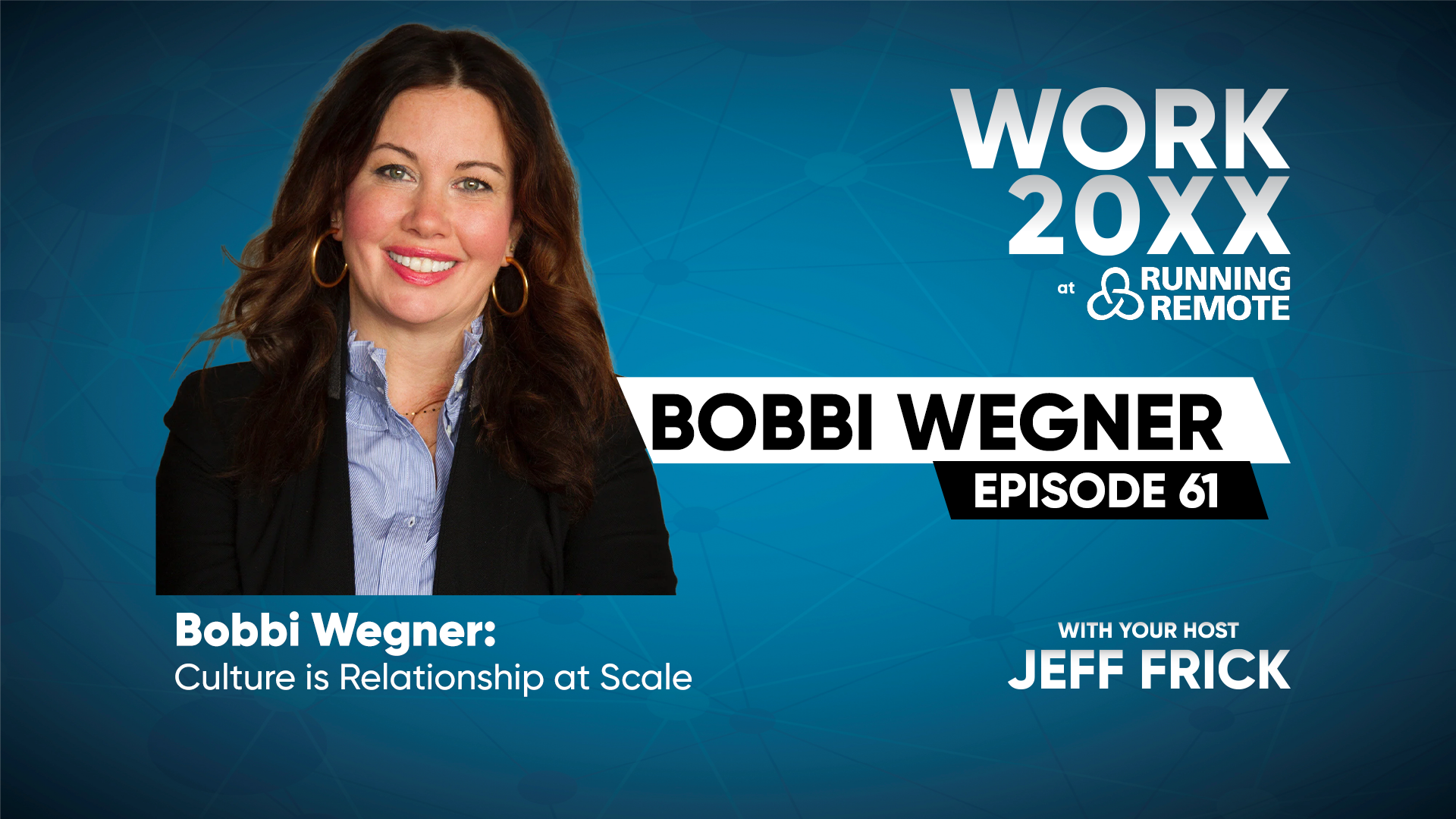
Bobbi Wegner: Culture Is Relationship at Scale | Work 20XX Ep 61
"We're hardwired for connection. We're social beings. We're animals with suits on. Tribes matter. Work tribes really matter. They drive outcomes." - Bobbi Wegner
Bobbi Wegner spoke at Running Remote as a clinical psychologist, trained to study the space between people. So what's the tie to remote work?
As Founder and CEO of Groops, Bobbi has built her career on a simple, solid foundation: people are social beings, hardwired for connection. "Animals in suits" was her phrase. And in this current version of our modern world, more micro-segmented and hyper-personalized than ever before, the environment is working against the building of connection and culture, especially at work.
Layer in the compounding stress of AI adoption and all the VUCA (Volatility, Uncertainty, Complexity, Ambiguity) that represents, and the negative can overwhelm efforts to increase connection. Our amygdalas are getting beat up all day long — notifications, uncertainty, job threat, existential noise — and a stressed, defensive amygdala is not a connecting brain. It's a surviving brain.
Please join me in welcoming Bobbi Wegner to the Work 20XX Podcast.
As Bobbi said, ‘Culture is Relationship at Scale.’
It's the sum total of every interaction between each person on the team.
We covered a number of topics: the thoughts-feelings-behavior chain that sits underneath every business outcome anyone actually cares about; the impossible squeeze on middle managers who are being asked to hold teams together with one hand while navigating their own uncertainty with the other; and the bifurcation — companies that double down on people plus the tool, versus companies using AI as cover to cut. She's clear on which ones win. Good psychology is good business.
Editor's Note: Recorded at the 2026 Running Remote conference in Austin, Texas. Special thanks to Liam, Egor, Ana, and the entire Running Remote team.
Episode Transcript
Bobbi Wegner: Culture Is Relationship at Scale | Work 20XX with Jeff Frick Ep 61
English Transcript
© Copyright 2026 Menlo Creek Media, llc.
—
Cold Open
All right. In three, two, one.
Host (Jeff Frick):
Hey, welcome back everybody, Jeff Frick here, coming to you from Running Remote in Austin, Texas. We were here last year and had to come back down because even though this conference is predominantly focused on remote work, most of the lessons on leadership, communication, behaviors are applicable across not only remote work but other organizations. And we're excited to have our next guest on. She is a specialist in helping people think about culture and connection and, as we'll soon learn, it has a lot more to do than just the right thing to do, as a lot of things are. It's also good for people and good for business. So, welcoming in our next guest, she’s Bobbi Wegner, the Founder and CEO of Groops.
Guest (Bobbi Wegner):
You got it.
Host (Jeff Frick):
Bobbi, great to see you.
Guest (Bobbi Wegner):
Thanks for having me, Jeff. Excited to be here.
Host (Jeff Frick):
Absolutely. So you're all about connection and cohesion.
Guest (Bobbi Wegner):
Yep.
Host (Jeff Frick):
Doing a little research for that.
Guest (Bobbi Wegner):
Yeah, yeah, yeah.
Host (Jeff Frick):
How did you pick to go after connection, and why is that such an important topic here in 2026?
Guest (Bobbi Wegner):
Absolutely. So I'm a clinical psychologist by training. I function more like an organizational psychologist really focused on the space between us. Right. So, like, there we think a lot through the lens of self, other, space, and between. But connection, we're hardwired for connection. We're social beings. We're animals with suits on. Right.
Host (Jeff Frick):
Right, right.
Guest (Bobbi Wegner):
So tribes matter. Work tribes really matter. They drive outcomes. So especially in remote environments where people are just kind of forced out, like, not out of, into disconnection. You have to be so thoughtful about how you’re bringing people together because it really impacts how we feel and how we perform.
Host (Jeff Frick):
So it's more and more challenging. You talked about kind of the paradox of our time. We're more connected than ever in terms of—
Guest (Bobbi Wegner):
Exactly.
Host (Jeff Frick):
the whole world is in our pocket, in our phone. At the same time, it's hyper-segmentation, micro-segmentation. Everyone is on their own little feed. So these kind of group cultural events that bring us together, even say in a sporting event, which used to be a great community builder
Guest (Bobbi Wegner):
Yeah.
Host (Jeff Frick):
even now, right, the levels of roped-off areas and this, even the segregation and separation of people, really, there's a lot of stuff working against these unifying, kind of shared cultural moments. So how do people get those back to build that connection?
Guest (Bobbi Wegner):
Yeah, I mean, this gets—this word gets overused a lot, but it's really, really important, which is like first understanding. I think the premise is you have to understand we’re hardwired for connection, social by nature, and technology and the way we're structuring our society is working against us in a lot of ways. It can make us more efficient or make things easier, but it's working against sort of natural connection and collaboration. And so think about, if we use a workplace as an example, those little touchpoints, right, of just like the water cooler chat or, you know, having lunch—I just had lunch with Laura and Ilya. Like, I don’t know, I didn't know these people, but these little moments of connection that are actually like feeding me as a human.
Host (Jeff Frick):
Right.
Guest (Bobbi Wegner):
And then when you're in a remote environment, you lose that. And so leaders kind of—when, especially coming out of COVID, backed into just leading remotely, but they had no playbook for like, how do you actually do this in a structured, intentional way? And it's not the same because you don't have those little moments anymore. So you have to build like—be very intentional. And it's not also just bringing people together. You have to know how to facilitate the connection. And that's where the psychology and coaching comes in.
Host (Jeff Frick):
Right, and have that connection, right.
Guest (Bobbi Wegner):
Yeah.
Host (Jeff Frick):
That's why I think Brian Elliott is famous for saying right is remote doesn't mean never together.
Guest (Bobbi Wegner):
Yeah.
Host (Jeff Frick):
You know, the thing that he loves to do with his teams is not just eat, but actually cook. And, you know, there's so many
Guest (Bobbi Wegner):
Exactly.
Host (Jeff Frick):
kind of cultural things around food and, and getting your hands in the dough or getting them greasy, whatever. So there are really simple. It seems simple, but they but it does take intention to build those bonds and connections.
Guest (Bobbi Wegner):
Yeah, and I, what I'm hearing in that is really the co-creation. Right, so the wise—one class I teach is motivation. What drives human behavior in the workplace, and how do you get people engaged in co-creation? And collaboration really matters because people feel more motivated when they're building something together, you know, and especially in the sort of distributed environment we're in now people are turning you know to kind of AI or doing their thing in silos and then coming back in for these touchpoints. But you don't feel like you're co-creating this kind of product with your team. I was just saying to our own COO although we focus on this all the time, this is what we work—we still are, it's like the cobbler's kid goes without shoes.
Host (Jeff Frick):
Right.
Guest (Bobbi Wegner):
We’re a remote company. And I was just getting good feedback from our COO saying like listen, I feel like you're doing all this work with sort of AI and she feels sort of boxed out in some way. And I was thinking of this parallel like Charlotte, our COO, is—is really my work wife and Claude is like my mistress, right? She's like easy. It's there. And you know, available at 9 p.m. I don't want to bother Charlotte. You know, I'm trying to, but that's not how you maintain a good relationship.
Host (Jeff Frick):
Right, right.
Guest (Bobbi Wegner):
And you have to have awareness and then have the—create the space to have those honest discussions around like how's this relationship going?
Host (Jeff Frick):
Right.
Guest (Bobbi Wegner):
You know.
Host (Jeff Frick):
And you talk about the way that feelings and how you feel about things does have a direct impact on behavior. And so when people are looking for whether it's efficiency or what I think is even more important is how do you get marginal effort out of people.
Guest (Bobbi Wegner):
Yeah.
Host (Jeff Frick):
How do you get them to pull a little harder because they believe versus either just showing up or really maybe not pulling that hard at all
Guest (Bobbi Wegner):
Yeah.
Host (Jeff Frick):
and that feelings do matter and they do drive behavior which then drives outcomes.
Guest (Bobbi Wegner):
That's exactly it
Host (Jeff Frick):
for the business.
Guest (Bobbi Wegner):
Yeah, so what we forget, you know, I always think of that visual of that iceberg. So all you can see is a behavior, right. Like we don't really know each other very well. Your—you can see my behaviors, my hands moving, my, you know, the words I’m saying, but you really have no idea what I'm thinking or feeling, right?
Host (Jeff Frick):
Right.
Guest (Bobbi Wegner):
I could be nervous, I could be, my mind's elsewhere. You have no idea. Right? And you don't know unless you ask. And so that's all we see in each other's behaviors. And what we know is feelings drive—our thoughts drive feelings. Feelings drive behaviors. Behaviors either reinforce that thought or not.
So as an example to make it more concrete, I have a thought. Jeff seems like a nice guy. Okay, I feel safe here. Therefore, I'm going to share—the behavior is going to be I'm going to be open because I'm, you know, I feel like Jeff's a good guy. If I thought Jeff was like super scary or going to set me up or a question I didn’t know, I’d feel anxious, I'd be shut down. Right. So the thought I have is driving the feeling. The feeling drives a behavior. That behavior either works for the company or it doesn't.
Host (Jeff Frick):
Right. Right. I love that. Another thing you've talked about is culture is relationship at scale.
Guest (Bobbi Wegner):
Yeah.
Host (Jeff Frick):
And I think that's a really interesting way to break it down, because I think people sometimes get wrapped around the axles. Culture. How do we build our culture? You know, they put up posters and they do this, that and the other when it's actually—it's the sum of all the little behaviors and relationships and those point-to-point touchpoints that everybody sees, the sum total of which is what the culture’s going to be, right?
Guest (Bobbi Wegner):
I mean, we're social relational beings and like the strength of the relationship dictates outcomes. So you can look at this through a health and wellness lens. And we know highly connected communities live longer, have better quality of life. Our Surgeon General, this is his main focus because it reduces cost from a medical front. Right.
Host (Jeff Frick):
Right, right.
Guest (Bobbi Wegner):
How do you create strong communities, decrease loneliness, all the things. You can look through the lens of the organization. It's the same thing, right? It's the same thing we crave. But that strength of the relationship drives things like retention, profitability, engagement—like everything. And it just comes down to the strength of the relationship. And we think—and we hear like, we talk about the word ‘culture’ and it feels so big. People will also talk about like we have a great culture versus realizing like that's stagnant. Just like relationships change. You don't have a great marriage, you have to build a great marriage day after day after day. The same thing holds true at work. You've got to invest. There's going to be periods of closeness, there's going to be periods of distance, and you have to be able to talk about that in a way that's like structured, intentional, and kind of makes people feel like they're in this thing.
Host (Jeff Frick):
Right. What's your advice for leaders when, I mean, I guess the waters are always choppy depending on where you look and what your perspectives are. But arguably we've been in some choppy waters right now with everything going on, and then you've got this kind of AI pressure which is big and scary and ugly, exciting and moving crazy fast. So from kind of a leadership and a cultural perspective, is there some things that people should make sure they're incorporating to be aware of how other people might be receiving, you know, these inputs?
Guest (Bobbi Wegner):
Absolutely. So when you think about, like, we work with a number of organizations from Fortune 50 companies down to an eight-person accounting firm on my company side. So we bring psychologists to work with teams and whatever, measure impact and things. And what we hear across all scale is stress and uncertainty are the two words. We say, like, how are you guys doing? You know, people are stressed, uncertain. I'm like, okay, well what does that mean? When people are stressed or uncertain, their amygdala is firing. They're not—they're in defensive mode. They're not optimized there because you’re like not sure if I'm going to get fired because AI is going to take my job.
Host (Jeff Frick):
Right, right.
Guest (Bobbi Wegner):
It's almost like being in a relationship and not sure if you're breaking up or staying together. You don't want to double down on the relationship if you think you're about to get, like, kicked to the curb. You know what I mean? It's the same thing at work. So AI is, you know, showing up in the workplace. People are like, be more efficient. That's a whole other conversation because there's a lot. AI adoption’s a behavior change.
Host (Jeff Frick):
Right.
Guest (Bobbi Wegner):
We don't think about it that way. You have to think about how people are feeling about it and then do they have the skills to do it, which we're also not thinking about. But the point is AI showing up. It's kind of like this threat to the relationship. People are feeling stressed, uncertain, not sure how to use it. And leaders are like, well just use this tool and go do it. And they're like, I don't know how to use this tool. Is it going to steal my identity or my data or replace me?
Host (Jeff Frick):
Right.
Guest (Bobbi Wegner):
Why would I do that? And it's not really being acknowledged on the sort of a psychological way, in a behavior change way, you know, but I think that's coming. I think we got this tool. It's new, it’s shiny, it's efficiency, all the things. But now it's like, okay, well, how is this thing impacting our relationship at work?
Host (Jeff Frick):
Right, right. And it just feels like our amygdala have been weaponized against us in so many ways. The poor thing is just getting beat all day long, between notifications— notification, notifications. Yeah, absolutely.
Guest (Bobbi Wegner):
Just petering out. It’s like, peace out.
Host (Jeff Frick):
Absolutely bananas.
Guest (Bobbi Wegner):
Yeah, there's something on that. When I was doing more clinical psychology, it’s like you—there's this sort of an—it's called, I think it's like the Yerkes-Dodson like curve. There’s like optimal level of stress and anxiety.
Host (Jeff Frick):
Right.
Guest (Bobbi Wegner):
You have to have enough arousal to like
Host (Jeff Frick):
Be awake.
Guest (Bobbi Wegner):
want to, to be awake, to do the job, to care. If we’re too apathetic, you're not going to care. You're not going to do it. And if you're too stressed, uncertain, aroused, you can't do it because you're stressed, right? But what we see—we see—we saw this in the clinical world was highly stressed, highly anxious people. Your amygdala, your body can't tolerate that level of stress over time. What ends up happening, it ends up dipping down to the back side of the curve. People get depressed. They're like—it's like learned—like this, I can't. This isn't working. So then they get depressed.
Host (Jeff Frick):
Right.
Guest (Bobbi Wegner):
So if we put that in organizational context, people want to do well. They want to perform like—they’re purpose-driven. We're contributors. You feel stressed. You are uncertain, you're in this state over a continuing amount of time, and you're not—it's not working. So you disengage. And then you leave. And this costs the company a bunch of money.
Host (Jeff Frick):
Yeah, yeah.
Guest (Bobbi Wegner):
And it doesn't feel good.
Host (Jeff Frick):
Right. I mean, what, the Gallup poll just came out—
Guest (Bobbi Wegner):
Yeah.
Host (Jeff Frick):
think is 1 in 4
Guest (Bobbi Wegner):
One in four.
Host (Jeff Frick):
or 1 in 5 people are disengaged at work. So, which reminds me of another great line we hear all the time, right? People don't quit companies. People quit managers.
Guest (Bobbi Wegner):
Exactly.
Host (Jeff Frick):
So I wonder if you can share kind of the special burden that line managers are under right now—
Guest (Bobbi Wegner):
Yeah.
Host (Jeff Frick):
because they're getting the heat from above to be faster and move faster with this AI tool. They've got to take care of their people, and they're sitting in the same position as everybody else in terms of the uncertainty and scariness of what's going on.
Host (Jeff Frick):
So when you counsel people on that special role of managers—
Guest (Bobbi Wegner):
Yeah.
Host (Jeff Frick):
that can make or break that relationship with that person, keep them there, inspire them to work hard. What are some special things for managers?
Guest (Bobbi Wegner):
Yeah.
Host (Jeff Frick):
How do they get through this wild time?
Guest (Bobbi Wegner):
I was just having a conversation with a guy at lunch and he was saying how, you know, managers get a lot of flak. You know, they're like everything falls on the middle manager.
Host (Jeff Frick):
Right, right.
Guest (Bobbi Wegner):
And so it's like, okay, well, I actually have a lot of empathy for middle managers because they're tasked with building cohesive teams in a distributed or hybrid or even a real-life environment.
Host (Jeff Frick):
Right.
Guest (Bobbi Wegner):
But they don't—they haven't been given the tools. Like at best they'll get a leadership training that's like, here's a framework on how you should think about it. But that really is not super effective, you know. So we built a whole thing. It's the way we train psychologists. So this concept of coach as leader. You cannot be a great therapist, a great coach, or leader if you don't understand your own habits of thinking, feeling, and doing. You don't understand your own value sets. If you don't understand how it maps against the values and the needs of the business and the organization, you need to take time to think about this. You know? So we're like, all right, we saw this huge need. How do we help managers first set the mission of their team? Most managers don't do this.
Host (Jeff Frick):
Right.
Guest (Bobbi Wegner):
What's the mission of this team that becomes the shared goal and like what we can get aligned around. So that's like step one. Then help the leaders, the middle managers, start to think about what are my natural characteristics. My habits of thinking, feeling, and doing that help build cohesion on a team and what gets in the way. I'll use myself as an example. One of my core values is autonomy. I like—I love connectedness and all this stuff. This is where I've like invested my entire life. I'm very autonomous. I like—can go off, I’m, you know, travel by myself all the time. I like that, I really value that.
Host (Jeff Frick):
Correct.
Guest (Bobbi Wegner):
So I can default to that. That can work against building a cohesive team when I default, because that's a value that I really care about. So I have to know that about myself. If I have to stay in communication with my team around is this working? Is it not working? And then teaching leaders some very basic coaching skills, looking for the shared goal, communicating through conflict, communicating about the relationship, naming the dynamics in the room that feels collaborative like you're solving together.
Host (Jeff Frick):
Right.
Guest (Bobbi Wegner):
Keeping people on the same side of the table versus like managers sometimes in missteps here kind of put the person on the other side of the table, and it just creates disconnection and you feel unsupported or understood by your manager.
Host (Jeff Frick):
It feels like corporations are reducing investment in people
Guest (Bobbi Wegner):
Yeah.
Host (Jeff Frick):
and not increasing investment in people. And I just think back to, you know, there used to be a lot more, feels like, maybe I'm wrong
Guest (Bobbi Wegner):
Yeah.
Host (Jeff Frick):
formal training programs and
Guest (Bobbi Wegner):
Yeah.
Host (Jeff Frick):
you know, all these different things. You know, IBM was famous for their sales team, and, you know, Accenture had their big St. Charles campus, and I came up in the Macy's training program.
Guest (Bobbi Wegner):
Yeah.
Host (Jeff Frick):
So are people not seeing that this AI actually is going to require more investment in the people side of people, not less, so that they can actually operate more effectively in this crazy world? Because it just feels like
Guest (Bobbi Wegner):
Yeah.
Host (Jeff Frick):
it's just a way to cut, cut, cut, or is it really a dividing line between companies that are progressive and really using the tool to grow versus companies that aren't and maybe just using it as an excuse to cut?
Guest (Bobbi Wegner):
Yeah, I spent a lot of time thinking about this. So the classes I teach are—there, you know, there are operators who are trying to figure out how to optimize their teams and organizations based on using psychology. And we spend a lot of time thinking about communication matters here. So I would say most leaders care. They’re not uncaring people,
Host (Jeff Frick):
Right.
Guest (Bobbi Wegner):
but they're responsible for the bottom line of the business. And like the people part, that kind of like compartmentalized is a nice to have. Like it's a feeling thing. And what I always say, I'm like, psychology is not rocket science, but it's there—pattern recognition. And once you can understand, it’s like seeing The Matrix. You can see the dynamics and then you can tie that to like, how do you optimize a team. And so what I found and what I help my students understand is like, you have to be the person who can communicate effectively to the grumpiest CFO who could—not saying CFOs are like this, I'm just picturing the grumpiest CFO who's just like, well then what is this weird psychology thing?
Host (Jeff Frick):
Right, right.
Guest (Bobbi Wegner):
The responsibility is on me to help make the translation around how this impacts things like retention, profitability, you know, all of those things, and then also measure it and show it.
Host (Jeff Frick):
Right.
Guest (Bobbi Wegner):
So that's like what we're trying to bridge. Building this platform is tying connection, cohesion on teams and then seeing the data live based on the unique productivity data of each team. So it makes it a easy—an easier sell for companies to say like, okay, now it's worth an investment.
Host (Jeff Frick):
Right. It's just weird. It just feels like there's this bifurcation happening
Guest (Bobbi Wegner):
Yeah.
Host (Jeff Frick):
between those that, that want to empower the people to do better with the tools. And then there’s the people that just want to get rid of the people and just plug in the tools
Guest (Bobbi Wegner):
Yeah.
Host (Jeff Frick):
and it, you know, we'll see how it shakes out. But it definitely feels like
Guest (Bobbi Wegner):
Yeah.
Host (Jeff Frick):
it’s diverting and those that double down on people I think are going to win because it's the people plus the tool.
Guest (Bobbi Wegner):
100%.
Host (Jeff Frick):
Right.
Guest (Bobbi Wegner):
I think there's a wave coming, right. So it's like we're in this like rapid growth part of society. We're never going to be growing this way. And so we're at this first thing, this new shiny adoption tool we're all adopting. But I think we're starting, I’m starting to see it now. Even like—even the layoffs, rehire kind of thing happening. People are like, what do we do with these people? Like, how do we navigate this? So I think it's like, just gonna take a minute. We're moving very quickly, but I think people are going to feel the pain of not tending to the people. Even if you don't care, you're going to feel it in terms of your bottom line.
Host (Jeff Frick):
Right, right.
Guest (Bobbi Wegner):
And then you have to think about, how am I going to solve for this? And that's not a clear-cut answer, which is hard. We as a society are figuring this out together right now.
Host (Jeff Frick):
Right, right.
Guest (Bobbi Wegner):
And the responsibility is on all of us to be like, this is what I'm seeing. This is what, you know, doing this kind of work, having conversations like this.
Host (Jeff Frick):
Right.
Guest (Bobbi Wegner):
What are you doing? What are you seeing? How can we co-solve this together? You know, it's not written yet. We're writing this story as we go.
Host (Jeff Frick):
Right, right. Just another chapter in the crazy technology. But as always, each chapter goes a little bit faster than the one before, right? The acceleration just keeps going.
Guest (Bobbi Wegner):
And an opportunity. I see it as like really exciting.
Host (Jeff Frick):
Right.
Guest (Bobbi Wegner):
I was just saying to my team or my class yesterday, I'm like, we're so lucky to be here. These are all people from all over the globe coming together who are self-selecting in because we don't have the answers, but we're talking a lot about how you solve these problems.
Host (Jeff Frick):
Yeah.
Guest (Bobbi Wegner):
How do you optimize? How do you like, get teams to work better together, to feel good, and then like tie it to business outcomes? And we're just like figuring it out live together and we're learning from each other.
Host (Jeff Frick)
Right? Right. But that's what these types of conferences do too, you know.
Guest (Bobbi Wegner):
Yeah.
Host (Jeff Frick:)
Well, keep up the good work so we can all keep learning from you and
Guest (Bobbi Wegner):
I don’t know.
Host (Jeff Frick):
putting out the classes and everything. So I really appreciate your time and really appreciate your work. It’s super, super important work and makes a real big difference for people.
Guest (Bobbi Wegner):
Well, same too. Thank you so much for having me and just hosting these conversations. I loved it.
Host (Jeff Frick)
Absolutely. My pleasure. All right.She's Bobbi, I'm Jeff, you're watching Work 20XX from Running Remote in Austin. Thanks for watching. Thanks for listening on the podcast. Catch you next time. Take care. Bye bye.
Cold Close
[Applause] Yeah.
That was fun.
Bobbi Wegner: Culture Is Relationship at Scale | Work 20XX with Jeff Frick Ep 61
English Transcript
© Copyright 2026 Menlo Creek Media, llc.
Bobbi Wegner: Culture Is Relationship at Scale | Work 20XX with Jeff Frick Ep 61
Links & References
Bobbi Wegner
Website - https://www.drbobbiwegner.com/
LinkedIn - https://www.linkedin.com/in/bobbiwegner/
Groops - https://www.joingroops.com/
Harvard Faculty Profile - https://extension.harvard.edu/faculty/bobbi-wegner/
TEDx Talks
- TEDxWolfeboro — "Raising Conscious Boys in an Unconscious World" (2018)
On implicit gender bias and how early conversations shape children's behavior and cultural norms:
ted.com/talks/bobbi_wegner_raising_conscious_boys_in_an_unconscious_world - TEDxWPI (Worcester Polytechnic Institute) — "Feminist Boys Are Our Future Men: Changing the Culture of Sexual Violence from a Very Early Age" (2018)
On the brain's role in unconsciously gender-typing women and how it feeds a culture of inequity: ted.com/talks/bobbi_wegner_feminist_boys_are_our_future_men_changing_the_culture_of_sexual_violence_from_a_very_early_age - TEDxDartmouth — "Paradigm Shift" event (2018)
On stress, parenting culture, and raising emotionally durable kids:
ted.com/tedx/events/24435
Keynotes & Public Appearances (most recent first)
- Running Remote 2026 — Speaker, Austin, TX (May 2026): runningremote.com
- Win-Win Workplace Summit 2026 — Speaker, panel on human-centered design and the future of work: eventleaf.com/e/winwin2026
- HEAA Reunion Faculty Keynote — "From Disconnection to Reconnection," Harvard Extension Alumni Association (May 2025): youtube.com/watch?v=EbNWZHkG_8A
Podcast Appearances
- Humanity Working / BillionMinds — "The Power of Groops with Bobbi Wegner, Psy.D." (September 2022): Apple Podcasts
Harvard
- Bobbi Wegner — Harvard Extension School Faculty Profile: extension.harvard.edu/faculty/bobbi-wegner
- Courses taught: Motivation: What Drives Human Behavior at Work; Team Psychology; Applied Coaching; Groups & Culture
Book
- Raising Feminist Boys: How to Talk to Your Child about Gender, Consent, and Empathy — Bobbi Wegner (2021): Amazon
Research & Studies Referenced in the Interview
- Gallup State of the Global Workplace 2026 — Only 20% of employees worldwide were engaged in 2025, costing the global economy $10 trillion in lost productivity. Manager engagement dropped five points between 2024 and 2025, from 27% to 22%: gallup.com/workplace/349484/state-of-the-global-workplace.aspx
- Gallup State of the Global Workplace 2025 — Global employee engagement fell to 21% in 2024; managers account for 70% of the variance in team engagement, yet fewer than half had received any formal management training: gallup.com/workplace/349484/state-of-the-global-workplace.aspx
- U.S. Surgeon General's Advisory: Our Epidemic of Loneliness and Isolation (Dr. Vivek Murthy, 2023) — Lacking social connection can increase the risk of premature death as much as smoking up to 15 cigarettes a day. Social connection is a national public health priority: hhs.gov/sites/default/files/surgeon-general-social-connection-advisory.pdf
- Yerkes-Dodson Law — Referenced by Bobbi in discussing optimal vs. excessive stress. The principle describes the inverted-U relationship between arousal and performance: moderate stress produces peak output; too little or too much degrades it: simplypsychology.org/what-is-the-yerkes-dodson-law.html
Conference
- Running Remote 2026, Austin, Texas: runningremote.com
---
Bobbi Wegner: Culture Is Relationship at Scale | Work 20XX with Jeff Frick Ep 61
© Copyright 2026 Menlo Creek Media, llc.
------
Disclaimer and Disclosure
All products, product names, companies, logos, names, brands, service names, trademarks, registered trademarks, and registered trademarks (collectively, *identifiers) are the property of their respective owners. All *identifiers used are for identification purposes only. Use of these *identifiers does not imply endorsement. Other trademarks are trade names that may be used in this document to refer to either the entities claiming the marks and/or names of their products and are the property of their respective owners.
We disclaim proprietary interest in the marks and names of others.
No representation is made or warranty given as to their content.
The user assumes all risks of use.
© Copyright 2026 Menlo Creek Media, llc.


Jeff Frick has helped literally tens of thousands of executives share their stories. In his latest show, Work 20XX, Jeff is sharpening the focus on the future of work, and all that it entails.