Tracy St.Dic: Rethink Hiring, Slope not Snapshot, AI Fluency, AI Interviews | Work 20XX Ep66


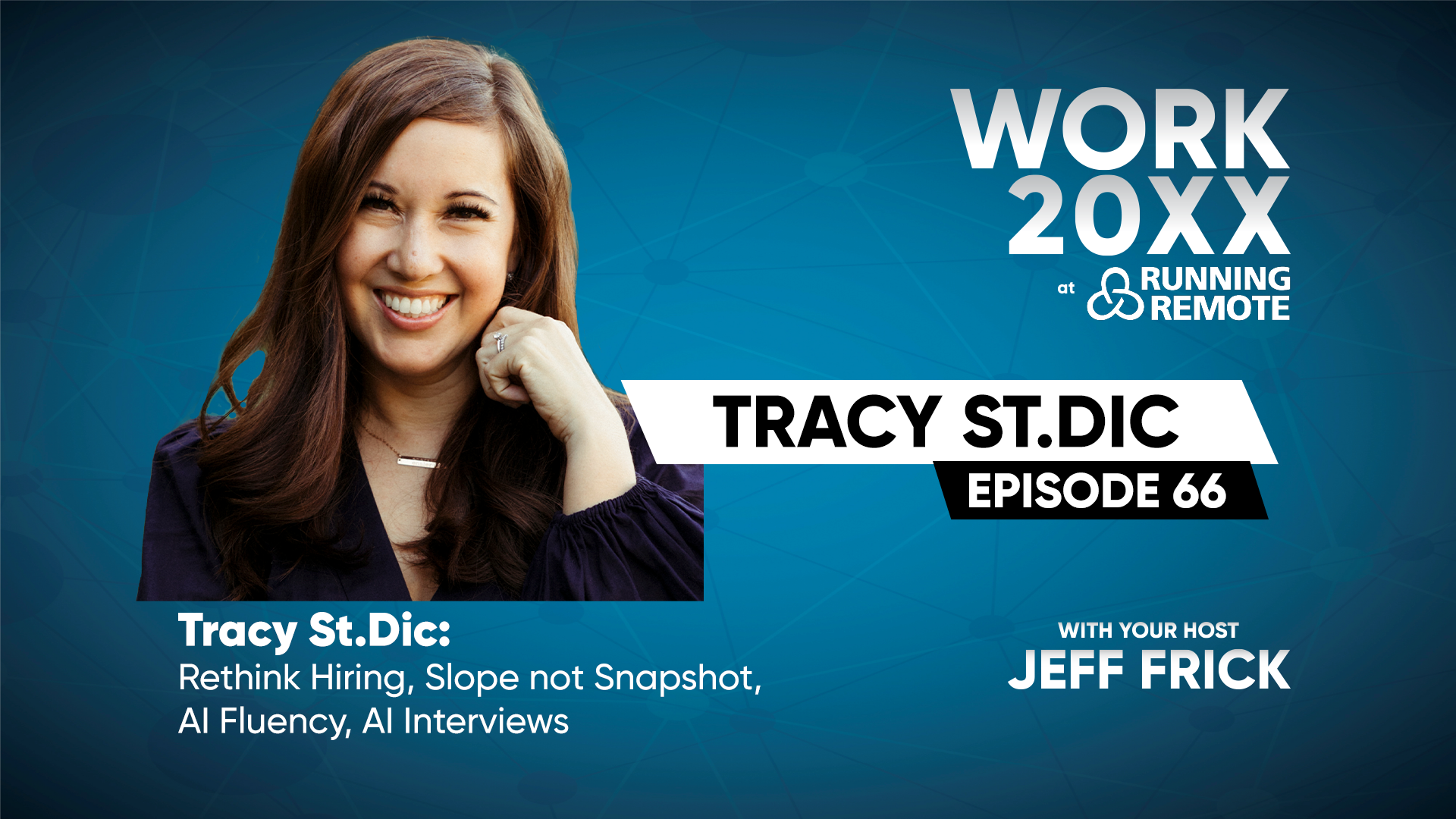
Tracy St.Dic: Rethink Hiring, Slope not Snapshot, AI Fluency, AI Interviews | Work 20XX Ep66
I am obsessed with redesigning hiring. Resumes are noise Applications are noise. How do we break down hiring to its real essential components, talent identification. talent evaluation, and the candidates evaluation of the company - Tracy St.Dc
Tracy St.Dic came to Running Remote as Global Head of Talent at Zapier, a company that has been remote since before remote was a decision anyone had to defend. So what's the tie to remote work?
It's the documentation. Remote companies live or die by writing things down, because you can't tap someone on the shoulder and ask. That habit, forced by being distributed, turns out to be exactly what AI needs to be useful: context, process, decisions, all captured somewhere instead of living in someone's head or laptop. Zapier's documentation-first culture isn't just how they operate as a distributed team. It's the substrate their AI tools actually run on. The company was already built for this moment before this moment existed.
Please join me in welcoming Tracy St.Dic to the Work 20XX Podcast.
That same instinct, write it down, don't rely on tribal knowledge, shows up in how Tracy thinks about hiring. Slope, not snapshot, is the phrase she keeps coming back to. She's not asking where a candidate stands today. She's asking what direction they're moving in, and how fast. Zapier built an AI fluency rubric around that idea, one of the first of its kind, open-sourced it to the community, and has already rebuilt it once as the bar for "capable" kept climbing out from under them. When they raised the bar, they didn't just start screening more people out. They raised the level of support too, so candidates had an actual path to reach it.
We covered a lot of ground: how Zapier's four-part fluency framework (mindset, strategy, builder skills, and now accountability and discernment) gets assessed; why an AI voice interviewer turned out to be more patient than most humans, and why candidates and recruiters both seem to prefer it; and the point Tracy keeps landing on about resumes, that they were never carrying much signal to begin with. Everything else, she says, is noise.
Editor's Note: Recorded at the 2026 Running Remote conference in Austin, Texas. Special thanks to Liam, Egor, Ana, and the entire Running Remote team.
Episode Transcript
Tracy St.Dic: Rethink Hiring, Slope not Snapshot, AI Fluency, AI Interviews | Work 20XX podcast with Jeff Frick Ep 66 from Running Remote
English Transcript
© Copyright 2026 Menlo Creek Media, llc.
---
[Cold Open]
In three, two, one.
---
Jeff Frick (Host):
Hey, welcome back, everybody Jeff Frick here coming to you from Austin, Texas. That's right. Work 20XX is on the road. We're back to Running Remote for our second year in a row because as we find out all the things that are talked about here that are kind of couched around remote work are actually all really good processes that people can use regardless of whether you're remote, hybrid, or everybody's back in the office. And we're excited to have our next guest because she is right in the middle of the storm of what is going on with AI so welcoming in she's Tracy St. Dic, the Global Head of Talent at Zapier. Tracy, great to see you.
Tracy St.Dic (Guest):
Thanks for having me here. This is great.
Jeff Frick (Host):
So Zapier was way ahead of the curve on basically giving these little bots agency to go and connect things and do things Suddenly, I mean, we were just at the Google Cloud Next show last week Agentic AI is all the rage and so it must feel pretty interesting to kind of have the market come to you as on an exciting point of view. On the other hand suddenly your competitive world got a lot different.
Tracy St.Dic (Guest):
It's so it's such a fun time to be, I think not just in tech, but just in you know people work in general and the world in general. It's been really interesting because Zapier is an AI orchestration platform and so what's really interesting right now is that people are feeling all sorts of anxiety around, am I using the right tools? Am I using the best tools? You know, we don't even know what the best tools are going to be six months from now, right? Because things just—
Jeff Frick (Host):
Six months? Six days!
Tracy St.Dic (Guest):
Yeah, It's changing so rapidly, like should I be using Anthropic? Should I be using OpenAI? Should I be using what like some other things and so what’s kind of funny is that Zapier is in a fun place because we sort of sit right in the middle of it. Zapier is the connective tissue between all of those things and we're really trying to help future proof people's workflows because whether you use Claude or whether you use you know, ChatGPT you can switch those in and out, whether you use this ATS [Applicant Tracking System] or that ATS [Applicant Tracking System] you can switch it out, but I think the future is moving to this direction of like we have to have more interoperability because the tools are changing so rapidly.
Jeff Frick (Host):
Right.
Tracy St.Dic (Guest):
And so people are looking for solutions where, you know, how do I future proof my tech stack? How do I think about what's the right tool. And, you know is that even necessary right now, so.
Jeff Frick (Host):
I'm curious your perspective your point of view on the human perspective as you know, ChatGPT was kind of the big moment for a lot of people and for the industry when that hit. And that was kind of the big deal. And then a couple of years passed, and now suddenly everyone's writing little chat bots. And that was kind of the thing and then here we are with agentic but from from your point of view, to see a little bit broader kind of understanding, knowledge, awareness of these tools and where they're going to go must be fascinating.
Tracy St.Dic (Guest):
It really is. And I think it's specifically interesting because we don't know where it's going to go next. You're right. And it's moving so quickly and so on the panel that I was just on we were talking about, you know some people still feel very behind in AI and it can feel very intimidating. Lots of anxiety, fear. Am I going to lose my job because I don't know how to use AI all the things like that. But the delta between I haven't started and I feel behind to like I'm in it and I feel ahead is very small. It's smaller than it's ever been because it's really just takes like time and reps to get there so start off we tell people like, you know start off with basic automation.
Tracy St.Dic (Guest):
Zapier started as an automation company back in 2011 and so we’ve always had this backbone of using automations. Well, now AI is putting more power into that. It's helping you figure out what those next workflows can be. Right. And so we tell people, start small. Maybe it starts with automations and then you move into agents and then you move into AI coding tools like Cursor, Claude Code. And then you're moving into the MCP connections and the SDK connections, you know, whatever is the next thing. And so it's always going to keep going. But I feel like people need to kind of jump on the train and just start playing around with it and starting small.
Jeff Frick (Host):
Right.
Tracy St.Dic (Guest):
But we've seen in the past I've been at Zapier for four years. We went from really just a purely automations focused company to ChatGPT, the ChatGPT 3 comes out, really changed the game in the tech industry and from then we've just been accelerating, but But every few I was going to say months, but I think days a new model or something comes out and it's impossible to stay ahead. So you just kind of have to be along for the ride, right.
Jeff Frick (Host):
So you guys are leading edge so we can see what you're doing on the people side, and you're Head of People and getting ready for this I found you know you talk about AI fluency and that is an important attribute for people. And I love the word that you use fluency. Because the other thing you said is I don't want a snapshot of the person today. I want to kind of know where they are because we're not really worried about today. We want this person to be successful with us tomorrow. So share a little bit about your—what's it called, the...
Tracy St.Dic (Guest):
The AI Fluency rubric, yeah.
Jeff Frick (Host):
the rubric right. and you ‘ve got talk about it.
Tracy St.Dic (Guest):
Absolutely. OK, you're gonna have to cut me off because I love talking about this, so—
Jeff Frick (Host):
Go, go, go.
Tracy St.Dic (Guest):
So as ahead of talent
Jeff Frick (Host):
Go Tracy Go.
Tracy St.Dic (Guest):
As the Head of Talent at Zapier. We determined as a talent strategy that we were going to set a minimum bar for AI fluency. And one—
Jeff Frick (Host):
When? When did you do that? how far along ago?
Tracy St.Dic (Guest):
We did that so we started this work last spring in 2025
Jeff Frick (Host):
Okay.
Tracy St.Dic (Guest):
and we launched our first version of the AI fluency rubric at the end of May 2025, beginning of June.
Jeff Frick (Host):
Okay.
Tracy St.Dic (Guest):
And what was interesting is when we we're very, we’re a transparent company, we open sourced a lot of stuff. We think that's part of how we get better. And so we put it out there in the community and it was the first time I don't want to say the first time but it was one of the first times one of the first companies I think where we actually defined what AI fluency meant and defined how we were going to assess for it, and said we're also going to support candidates to reach that bar because when you raise the bar you have to raise the level of support for people to reach it. It was so new to folks at that time a lot of our minimum capable bar was like are you using LLMs for a purpose, right? So just a couple of weeks ago we put out our second version of the AI fluency rubric and the bar has drastically changed. But just to break it down in terms of the components, the things that we look for are now there are four. It's AI mindset, strategy, builder skills. And now we've added accountability and discernment. And just to kind of share what that means mindset is how are people embracing AI. Are they curious about AI? Are they, you know, experimented with AI? How are you leaning into this moment? Because that's going to predict a little bit of the future how you're going to lean into new technology.
Jeff Frick (Host):
Okay.
Tracy St.Dic (Guest):
Strategy, which I used to call strategic acumen, is more function specific.
Tracy St.Dic (Guest):
So how am I, as a talent leader, thinking about the future of hiring with AI? If I was an accountant, how would I think about the future of accounting? So we want to see how people are thinking about evolving their work, but also their function with a more AI native future. Builder skills is like the more technical components. We're very tool agnostic which I think is important because the tools are changing all the time.
Jeff Frick (Host):
Right, right.
Tracy St.Dic (Guest):
So it doesn't matter what tool you use, but show us how you use the tool. I want to see how you think not just I know how to use this specific tool that might be obsolete, like six months from now. And then accountability and discernment felt like a very important add because with so much AI slop out there. How do we know what's good and not? When do we use AI? When don't we? What is, you know what do I do when the output isn't great? How are we working with it? So those are the four components. And then we have a, you know unacceptable bar, but a capable minimum bar that everybody no matter if you’re an engineer or an accountant, you have to meet to work at Zapier. Then we have adoptive and then we have transformative which is a very high bar. And that's really people who are completely redesigning their work their teams work. Very few people even now ever meet that bar less than 5% if that meet that bar in our hiring process. And then we assess it at the hiring you know, the application stage and recruiter screen. We assess it with a skills interview, which we've now moved to more live. So we can actually see how people think. And then we assess it again at the end with an executive interview. And those four touch points are really important To the point that you said before is we look at the slope and not just the snapshot. So even within the hiring process if you came in and we're like Ooo, you're like barely meeting that bar of capable, let me give you some resources. Let me share with you some things that you can do. If people jump in and embrace that, and they start learning more about AI tooling and tools and playing around, experimenting And at the end of the process, they've been on this incredible learning curve that is such a signal to us like a meta signal of like Wow, they really learn quickly. Like that's going to give us a better positive, optimistic outlook of how this person is going to perform six months from now versus somebody who's like I use AI, but I've used the same three tools for the past three years I've never changed. Like that snapshot isn't going to do much for us.
Jeff Frick (Host):
Right.
Tracy St.Dic (Guest):
Because the future is changing so quickly.
Jeff Frick (Host):
So how are you doing? How are you helping internal people once they get inside move up that progression?
Tracy St.Dic (Guest):
Oh Yeah.
Jeff Frick (Host):
Because like you said there's not that really many people at that
Tracy St.Dic (Guest):
Oh Gosh.
Jeff Frick (Host):
kind of the top, top end.
Tracy St.Dic (Guest):
It’s such a domino effect So, you know, because we've set this bar, we’ve said this is what it means for hiring. We also really redesigned our onboarding process. So in week one, because of where people are coming in and hiring, they are hands on, hands on keyboard, starting to use things like Cursor and Claude Code for us right now, Connecting it with Zapier’s MCP so they have access to all of the tools that they might use. Slack, Granola, you know you know, Zoom, anything else. Right. So they're doing that in week one. And that we've seen that on ramp just gets so much faster. So it's hiring. It's onboarding. We also have weaved it into our performance management system. We've also then put it into how we do rewards and recognition. It's part of our you know, as we look at promotions, as we look at, you know, annual raises, all of that stuff. So we really put it in the entire spectrum. And then also internally we put a lot of effort in changing our rituals, our practices, so that people have not only the time to experiment and learn these things, but the community, the psychological safety. And we've really built like a culture around how you build your own fluency. Because when we put this rubric in place not everybody at Zapier was at that place.
Jeff Frick (Host):
Right, right, they got hired beforehand, right?
Tracy St.Dic (Guest):
And so, how do you, like meet in the middle? Is a lot of the work that we've been doing over the past few years. How do we internally upskill and support our team, and how do we bring in people who are going to meet us at or above that bar and so that we're really transforming our workplace from the front end and the back end?
Jeff Frick (Host):
I love it.
Tracy St.Dic (Guest):
Yeah.
Jeff Frick (Host):
So it's great because you have a little bit of a of the view of the future, I think over most organizations. And one of the things we hear about is two things. One is what happens when everybody shows up at the staff meeting with their own digital staff of 12 assistants. How does that get managed? But then specifically, you have a project the digital twin project, where every Zapier is going to have a digital twin. Not so much to to do that, but to take over more and more an increasing percentage of the drudgery work, I presume. Tell us a little bit about that project and how's it going?
Tracy St.Dic (Guest):
Yeah, what I love about this and we're sort of like in flight in that project, you can hear our CEO [Wade Foster] talks about his digital twin, his digital chief of staff. You know, a lot of people have different versions of this. But I think what's really cool about this is it's adding in the context layer not just of your own work and my goals, my responsibilities, my priorities. What's top of mind for me? Things I've written, things that I’m thinking about but also the context of the whole company. And so imagine, like I'll just give you a very simple example. I came back from PTO and I was gone for like a week and a half and I was able to go in and work with my digital twins and What did I miss? And It was able to pull in. What did I miss from all of the Slack messages that I had all of the meetings that I missed, all of the emails that I got, all of these things. But it knows the context of the company and it knows what my priorities are. So instead of saying here's a list of 100 things that you missed, it was able to say here's the five things you need to focus on this week as you jump back into your work. Right. And so that that in itself has been amazing because it knows my context so well. And as I work with it more I train it more and more so I can say Oh, you know what? That's not a priority any more now I'm focused on this. My AI digital twin can tell me, hey, based on your calendar, you're not actually really spending any time on that at all. It's a good way to put up a mirror and be like you say you care about this, but you're not. So it also, I love it because it not only helps amplify and you know, and speed up my work, but it also ensures I don't miss anything. It also holds me accountable and kind of like keep me in check a little bit, so
Jeff Frick (Host):
I love I mean, what is the impact of having a non-judgmental but critical partner that you can rely on? Because critical feedback and getting critical feedback giving critical feedback is not something most people are good at. Most people, a lot of people don't accept it well, but if it's kind of coming off your own schedule and the priorities that you set without judgment from this machine it’s got to open up a lot of kind of reflection and reprioritizing.
Tracy St.Dic (Guest):
You totally nailed it, because I think that that frees up a lot of people to be able to do their best work. So now, of course and you have to train your AI because right now it's like ‘Oh, Tracy, that was a great idea! That's awesome. Wonderful.’ You know you don't want it to just you know, think help you believe that everything that you're doing is right. And so we really think about like training our tools to say, okay, I need, you know, you to take this angle, this angle and this angle to poke holes in my thinking, ask me questions, so and it does take time. It takes time to work with that and train that and check the output. That's where the accountability comes in where I'm like, well it wasn't actually a good idea. I think you could have pushed me a little bit harder on it, but that's one of the things that we're thinking about at Zapier as we moved from individual AI to institutional AI, and that's more thinking about, Okay if we have all of the company context at Zapier, how can we create a coach for all of our employees at Zapier that hold by the same principles, the same values? So it's not just like how I've, you know trained my own digital twin but is there context where it's like, hey, these are the things we care about at Zapier. So it's pushing me, it's guiding me it’s coaching me in different ways understanding that sort of like the value system or the culture that we're trying to create and so I think we haven't gotten that far yet. I think there's a lot of possibilities there as companies start to go from you know everybody doing their own thing, choose their own adventure to like, okay, how are you actually pulling that together so that everyone's rowing in the same direction? And that's what us and a lot of companies are trying to figure out right now.
Jeff Frick (Host):
It’s great. Well, I think you guys are way ahead of the curve. Shifting gears a little bit. You do hire people. You're responsible for people. So presuming they can get through the rubric, it feels like a lot of the hiring process now. I talk to my kids and their friends. It's you know it's bots reading resumes and and keyword stuffing to try to get past the bot to read the resume. And it just feels like a very machine to machine process. Getting ready for this. You talked about a tool that you guys use, Ezra that's allowed you to both simultaneously process more, but then also find some of the gems that maybe wouldn't have got through the other process. I wonder if you could share how does that work, and how has that process yielded some great candidates that maybe wouldn't have got through the other machine to machine filter
Tracy St.Dic (Guest):
So I'll just say this if you asked me a year ago if I thought I would be using agentic AI recruiters with voice AI I would have been like, no, absolutely not. That's what recruiters do best. That's the human element. But, you know, I have really evolved my thinking over the past year, and I think a lot of candidates and a lot of the talent industry has as well. I think the sentiment is very much shifting because especially for us, we're a global tech company. We have thousands of applications, many of them fraudulent. I'll talk to my recruiters especially and
Jeff Frick (Host):
Many of them fraudulent.
Tracy St.Dic (Guest):
Fraudulent yeah, and fraud is like a spectrum, right? It could be. I'm just embellishing my resume to I am actually a malicious like player for, you know a foreign government, right.
Jeff Frick (Host):
That wants to get in, to get access to your systems, Okay.
Tracy St.Dic (Guest):
Exactly, Yeah. So it can be, when I say fraud it can be the whole spectrum.
Jeff Frick (Host):
Okay
Tracy St.Dic (Guest):
Everybody's embellished their resume like that’s a tale as old as time, right? But like then there's actually people who are creating a feeling of like, I have this experience and they absolutely do not. And so there's so much noise in the system, top of the funnel for hiring that we have to find a way to cut through it. And what I was finding the pain point for us is my recruiters were spending time getting on the phone for 30 minutes with people realizing that's a deep fake realizing this person absolutely did nothing that they said that they did. They were wasting so much time and feeling like they were also missing people who may have been authentic. But we never knew because we have thousands of applications and only this amount of time. So we demo’d a lot of different technology. We chose Ezra AI because I think it is is honestly, truly the most sophisticated, intelligent tool out there and I knew if I was going to put something in front of candidates it had to be the best, because already candidates were very hesitant especially at the time when we started doing this, but just to show you some things that we saw.
Jeff Frick (Host):
So one And what is the process when you say candidates?
Tracy St.Dic (Guest):
Yes
Jeff Frick (Host):
So it’s just, it's you have an interview with Ezra?
Tracy St.Dic (Guest):
Yeah. So we do right now. We do the application. We look at the applications we move forward probably about five times more candidates to the next stage than we would have normally if it were just going to a recruiter screen. We send them all to Ezra. They take a 15 to 20 minute voice AI screen where they jump on. They can take it any time zone any time that's convenient for them.
Jeff Frick (Host):
Nice
Tracy St.Dic (Guest):
So it's also actually got us to interview a lot faster I would say. It cut down from, oh gosh, I don't remember. It was like 5 to 8 days to actually get a person that we wanted to move forward to actually talk to a recruiter. Now that's less than three days where we're getting more information from them. So we really try to be transparent about how we're using it and why we're using it. So they talk to Ezra. Ezra asks great follow up questions. They ask consistently the same questions across every candidate. Follow up questions based on what they say. It can also answer questions about Zapier. So for the benefit of the candidate they can ask, what's this team like? What are the benefits like you know What is remote culture like? And we can load it with that information so it can answer more of those questions over time.
Jeff Frick (Host):
Right
Tracy St.Dic (Guest):
But the great thing is, is that one we have found especially in our early pilots about 30% of the candidates that we had said we probably wouldn't have met with if we were just doing recruiter screens, but we gave them kind of a chance to shine with Ezra and share a little bit more. 30% of those people in our earliest pilots we decided to move to a hiring manager screen and I call these the ‘Hidden Gems’ because those are people that are awesome that we just would not have moved because their resume didn't look as great as the next perfect resume that was generated by AI so it's allowing us to get a deeper look at candidates a more authentic look at candidates. And it also has a lot of fraud detection built in so it just generally feels like a more authentic experience. And what we're seeing is that even if, you know we are seeing some speed gains, but even more than that once we actually do get to talk to the human which is the very next step the rest of the process is very human. We know a lot more about that candidate and so we're able to jump in and they've already asked like all their basic questions to Ezra. So we're able to jump in where really thoughtful conversations, even more human to human connection with more information about them, but also more vetting of them more of them vetting the company. And that's also increased the quality of our decision making as well not just the speed of our decision making.
Jeff Frick (Host):
I love it. What’s been the feedback from the candidates that have gone through the whole process.
Tracy St.Dic (Guest):
Very good actually. And so this is where I was I was very intent on following this, so currently right now, if I'm not mistaken we have about a 4.6 out of five rating from all of our candidates. Something like 89% or more have rated it like a 4 or 5. The qualitative feedback is really interesting. A lot of candidates have said this was better than I thought. This was smoother than I thought. I was pleasantly surprised. So that's fun. And the times where we've had candidates not like it a lot of times it’s been because they said, Oh, well I was asking it all these questions about Zapier, but it couldn't give me the answers. And we're like that's fair. We haven't loaded it with enough of that context yet. So, you know, so there's some things that we're still building in this process. We don't use it for every role yet, but we're trying to like roll it in and slow roll it and do all the bias checks and do all the stuff that we need to do to make sure it's a really powerful tool. But so far, our recruiters are really liking it especially when we hire globally in places like India, it would take weeks to get a call on the books in the time zone that matches us and the candidates and now we can do that so much faster. So our recruiters are liking it, our candidates are liking it. And like I said, I think candidate sentiment is changing There's so many tools out there. There's so many well-known, trusted hiring platforms out there that are using some sort of voice AI. So I just think it's going to become a lot more normalized.
Jeff Frick (Host):
Yeah.
Tracy St.Dic (Guest):
And if people are going to be like, Yeah, this is normal, so.
Jeff Frick (Host):
Yeah. Well, it's good that the feedback is validating that.
Tracy St.Dic (Guest):
Yeah. Some people like talking to voice AI. more than a human which is a whole different issue, but it's interesting because we found that the voice AI doesn't cut people off. It has more patience so people can give a longer answer. They feel like there's no facial expressions to to judge them So some people have actually said I really like that I’m able to get out a lot more of my experience and my perspective with the AI voice first then a human that might be tired at the end of the day or,
Jeff Frick (Host):
Right, right.
Tracy St.Dic (Guest):
You know, have an expression on their face that they don't mean that feels intimidating you know, so I think is going to be really interesting to see what happens.
Jeff Frick (Host):
That's wild. And plus the consistency on in terms of the delivery of the questions has got to be so much higher than people trying to interview a thousand people.
Tracy St.Dic (Guest):
Yeah.
Jeff Frick (Host):
All right Tracy, so you're on the cutting edge. Last question. What are some of your priorities for this year as you look forward? You got so many things going on. What are you excited about for this year? All of it or any any particular priorities you want to highlight?
Tracy St.Dic (Guest):
Yes. I am obsessed with this idea of redesigning how we do hiring. Just take what we were talking about. We have so many fraudulent applicants. Resumes all look like one another. You can't pick out like nothing in a resume gives me any information except where you worked and how long you worked there. Everything else is noise Applications are noise. I'm like, very obsessed with this idea of how do we break down hiring to its real essential components, which I think there are only three. Talent identification. Talent evaluation, both skill wise and fit wise. And then the candidates evaluation of the company because it's a two way street like we're evaluating you, but you're evaluating us. That's the only three things that is important in a hiring process resumes, applications, all of that were built to serve as filters that are no longer serving us. So what is the new era of hiring look like? I don't know, I'm trying to find out. Talking to a lot of talent leaders to find out, but I'm obsessed with answering that question. And I think that there's a lot of pieces in TA that are legacy systems and talent, that are legacy systems that need to be redesigned in this new AI forward future and luckily at Zapier I get a big sandbox and a lot of wind at my back to try to figure that out.
Jeff Frick (Host):
That's awesome.
Tracy St.Dic (Guest):
Yeah
Jeff Frick (Host):
So I'll give you one last line on resumes that I heard from somebody
Tracy St.Dic (Guest):
Okay, okay
Jeff Frick (Host):
I thought was classic Is a resume’s a list of things I no longer want to do.
Tracy St.Dic (Guest):
Yeah, I love that.
Jeff Frick (Host):
Why are you using that to judge me for what I want to do next?
Tracy St.Dic (Guest):
I love that. That’s awesome.
Jeff Frick (Host):
All right. Well, Tracy, thanks a lot. Love the energy congrats to you and Zapier for doing the right thing being the right place at the right time, and then jumping on kind of this next wave of opportunity. Exciting times.
Tracy St.Dic (Guest):
Thanks for having me. This is fun.
Jeff Frick (Host):
Absolutely. All right. She's Tracy, I'm Jeff. You're watching Work 20XX from Running Remote Thanks for watching. Thanks for listening on the podcast. Catch you next time. Take care. Bye bye.
[Cold Close]
[applause]
Yeah.
Cool.
Awesome
That was so fun
That was great.
I loved it
Links & References
Tracy St.Dic
Global Head of Talent, Zapier
Connect with Tracy
LinkedIn: linkedin.com/in/tracy-stdic
Zapier author bio: zapier.com/blog/author/tracy-stdic
Zapier: zapier.com
Zapier Jobs: zapier.com/jobs
Recognized on HIGHER Talent100 2025 Global Power List
Recognized on HIGHER Talent100 2024 Global Power List
Select Writing
2026-Mar-31
One year later: Raising the AI fluency bar for every Zapier hire by Tracy St.Dic
Zapier Blog
Follow-up piece one year into Zapier's AI fluency framework for hiring.
https://zapier.com/blog/raising-ai-fluency-bar-in-hiring/
The 4 primary components of AI Fluency
- Component 1: Mindset
Continuously learning and experimenting with AI. - Component 2: Strategy
Deciding where AI belongs in the work and why. - Component 3: Building
Partnering with AI to produce quality results through clear communication and iteration. - Component 4: Accountability
Applying human judgement to define success, evaluate outputs, and own the results
2026-Mar-04
AI recruiter screens: What we learned and why we’ll keep going by Tracy St.Dic
Zapier Blog
Transparency update on Zapier's AI recruiter (Ezra) pilot: recruiter time savings, screen-to-review turnaround, and guardrails that keep hiring decisions human
https://zapier.com/blog/ai-recruiter-insights/
2026-Feb-26
The 4 Stages of AI maturity: A Framework by Kiran Shahid
Zapier Blog
https://zapier.com/blog/ai-maturity/
- Stage 1: Individual AI experiments
For most organizations, this is where AI adoption begins: individual experimentation. It's a fast, low-friction way to learn what AI can actually do for your business workflows. . - Stage 2: Connected AI workflows
At this stage, AI stops living in side projects and starts showing up in core systems. The shift often happens when early experiments prove valuable enough to formalize. . - Stage 3: Governed AI workflows
This stage is where AI orchestration becomes formalized. Workflows span departments, ownership is defined, and guardrails are no longer optional. As AI becomes embedded in core operations, reliability and governance take center stage. - Stage 4: Adaptive AI systems
This is the stage where AI orchestration becomes adaptive. Work isn't just automated; it's continuously refined based on outcomes. Instead of asking how to automate a task, teams focus on improving how the entire system performs over time.
2026-Feb-02
How to measure your AI fluency - and move to the next level By Jessica Lau
Zapier Blog
https://zapier.com/blog/ai-fluency/
- Level 1: Unacceptable
This stage is a common starting point, especially for people who haven't had the time, support, or context to explore AI meaningfully yet. It doesn't reflect a lack of ability. Instead, it usually reflects limited exposure, uncertainty about expectations, or valid concerns about risk. - Level 2: Capable
At this stage, you've crossed an important threshold: you're using AI on purpose. You may still be early in your journey, but you have real experience and momentum to build on. - Level 3: Adoptive
At the adoptive stage, AI is no longer an experiment, it's a dependable part of how you work. You're thoughtful about outcomes, aware of limitations, and continuously improving how you use AI. - Level 4: Transformative
This stage reflects impact at scale. AI has fundamentally changed how you approach work, and that new way of working influences others—your team, your projects, or even your function.
2025-November-10
Applying to Zapier? Here’s wy you might meet an AI recruiter by Tracy St.Dic
Zapier Blog
On Zapier's use of an agentic AI recruiter in the hiring funnel and how it's meant to boost efficiency and fairness while keeping the final call human
https://zapier.com/blog/zapier-ai-recruiters/
Select Podcasts
2026-Jun-23
Hiring for AI Fluency: Tracy St.Dic on How Zapier Raised the Bar for Every Hire
Matchr Podcast, Episode 28
Guest conversation on Zapier's AI fluency rubric, the "2023 code red" that started Zapier's AI fluency push, the AI recruiter at the top of the funnel, and rebuilding hiring for an AI-enabled world.
https://matchr.io/podcast/hiring-for-ai-fluency-tracy-st-dic-zapier
https://www.youtube.com/watch?v=9zszo41vX_Q
2026-May-28
Building an AI-Native TA Organization - recorded LIVE at BrightHire Shine 2026
The Debrief LIVE Episode 7 podcast with Ben Sesser, Tracy St.Dic, Chris Abbas and Scott Dicke.
Live studio-audience episode with Benjamin Sesser and Chris Abbass on building an AI-native TA team, evaluating AI fluency in candidates, and "slope, not snapshot" as an evaluation lens
https://open.spotify.com/episode/2G19VDMOSya8KToug4DJGU?si=_AOX6v3GT6SYvC4SuQNz6Q
2026-May-26
How Zapier Uses Agentic AI in Recruiting, Levels of AI Fluency. Tracy St.Dic, Global Head of Talent
Expert’s Path podcast with Damian Puodziunas
https://www.youtube.com/watch?v=ajWGBxKWghc
2026-May-05
TA orchestration: The future of hiring | Tracy St.Dic, Zapier
The Recruiting Roadshow podcast Ep. 10
https://www.youtube.com/watch?v=l65RF0zgUsc
2026-Mar-10
AI is Already Interviewing You - Are you Ready - Tracy St.Dic
Call HR Podcast Michelle Volberg
Discusses how Tracy's team uses AI to interview candidates at Zapier, standing out in a competitive job market, and the right/wrong ways to use AI in an interview.
https://creators.spotify.com/pod/profile/zoe-bank/episodes/AI-Is-Already-Interviewing-You--Are-You-Ready---With-Tracy-St--Dic--Global-Head-of-Talent-at-Zapier-e3g201v
2025-Oct-08
Unlocking Talent Agility: A Conversation with Tracy St. Dic ~ Ep 33
WRKdefined Audio podcast with Krista Tan and Natalie Stones
Covers talent agility, fostering internal mobility, and using technology to support workforce adaptability.
https://www.youtube.com/watch?v=p22gCNwgEHY
2025-May-21
HIGHERHER EP 33 - Tracy St.Dic
Talent Collective Podcast with Krista Tan and Natalie Stones
Covers talent agility, fostering internal mobility, and using technology to support workforce adaptability
https://www.youtube.com/watch?v=8r1RvBiIZ6s
2023-June-08
L&D Plus Talent: How Zapier’s Internal Mobility Program Helps Boost Organizational Resilience with Tracy St.Dic & Colin Monaghan
360Learning Podcast with Tom Baragwanath
https://360learning.com/blog/l-and-d-plus-zapier-internal-mobility/
Select Articles
October 22, 2025
"From 'AI Bar' to Day 1 Impact: AI Fluency with Tracy St.Dic"
Pivotal (London) AI Fluency Series
Second feature in Pivotal's AI Fluency Series;
Tracy walks through how Zapier built and shipped its AI fluency rubric in four-to-six weeks.
https://www.pivotallondon.co.uk/knowledge-hub/blogs/view/117/from-ai-bar-to-day-1-impact-ai-fluency-with-tracy-st-dic.aspx
—--------------------------------
Disclaimer and Disclosure
All products, product names, companies, logos, names, brands, service names, trademarks, registered trademarks, and registered trademarks (collectively, *identifiers) are the property of their respective owners. All *identifiers used are for identification purposes only. Use of these *identifiers does not imply endorsement. Other trademarks are trade names that may be used in this document to refer to either the entities claiming the marks and/or names of their products and are the property of their respective owners.
We disclaim proprietary interest in the marks and names of others.
No representation is made or warranty given as to their content.
The user assumes all risks of use.
© Copyright 2026 Menlo Creek Media, llc.


Jeff Frick has helped literally tens of thousands of executives share their stories. In his latest show, Work 20XX, Jeff is sharpening the focus on the future of work, and all that it entails.