Sacha Connor v3: Not Technical, No Excuse, Leading AI Adoption | Work 20XX Ep65


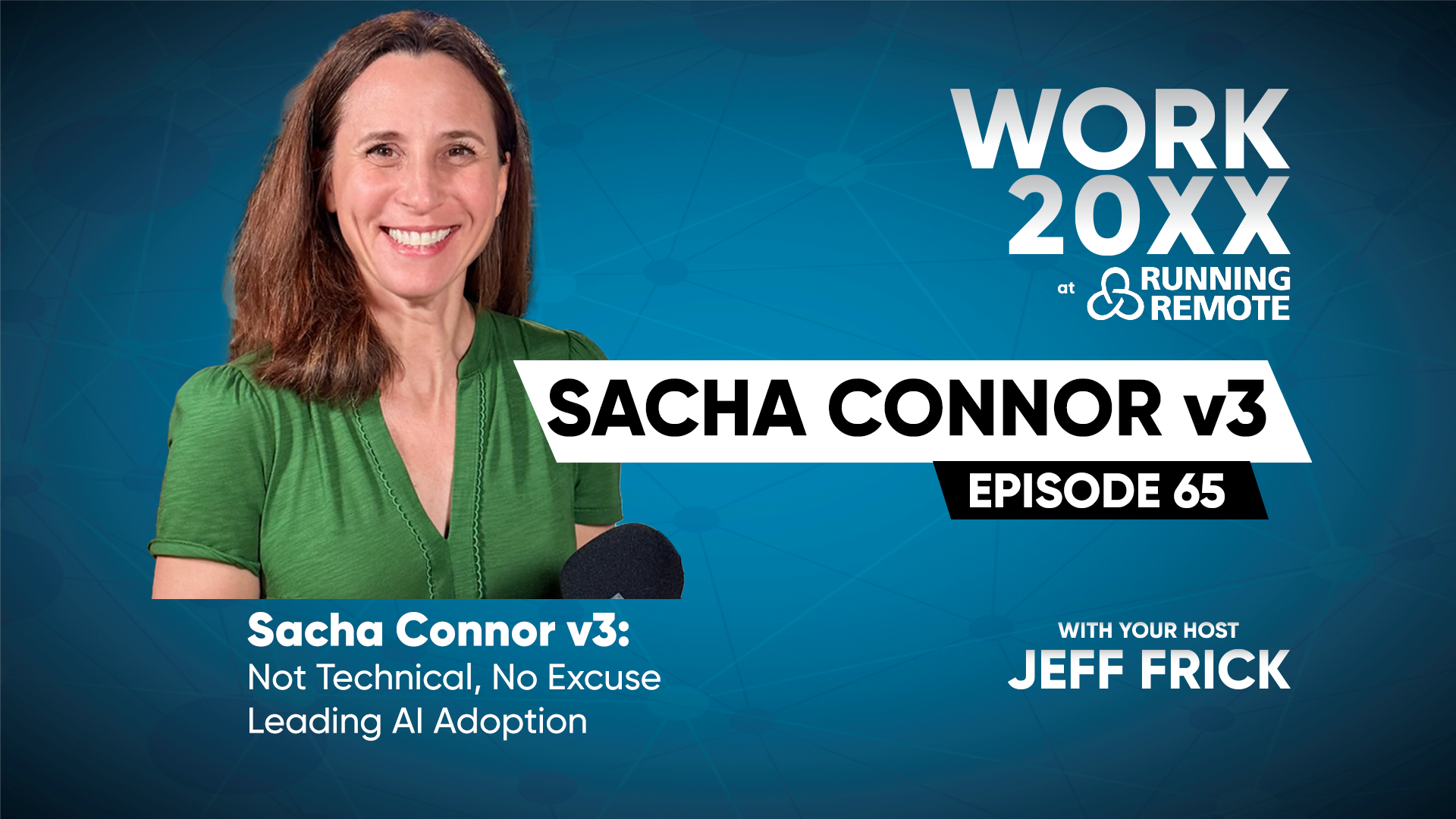
Sacha Connor v3: Not Technical, No Excuse, Leading AI Adoption | Work 20XX Ep65
"I don't see myself as a technical person. I was scared of it of it at first. I was like, this isn't for me. I don't know how to code. And then I took the Lead with AI certification program and I realized that actually you don't need to have that technical background, that I could actually really relate a lot to what I was learning. And it was a lot more a lot easier for me to experiment than I ever thought. Start to experiment." - Sacha Connor
Sacha Connor: Not Technical, No Excuse, Leading AI Adoption | Work 20XX with Jeff Frick Ep 65 from Running Remote
Sacha Connor first came to Running Remote in 2019, when the conference was still held in Bali. This year marks her third appearance on Work 20XX, and her fifteen-year remote-iversary.
What a fun catch-up with Sacha from Running Remote in Austin, watching the conversation at this conference evolve in real time across the years we have both been showing up.
Sacha's path into this work traces back to 2010, when she asked The Clorox Company if she could keep her position and move 3,000 miles away, fully remote. They said yes, with a long list of career-altering caveats attached. She took the deal anyway, spent the next eight years leading distributed teams from Philadelphia, and eventually got Clorox to decouple location from career potential entirely. She co-founded ORBIT, one of the company's first remote-focused employee resource groups, and it became the largest and fastest growing ERG at Clorox almost overnight. In 2018 she left to start Virtual Work Insider.
Please join me in welcoming Sacha Connor back to the Work 20XX podcast.
The heart of this conversation is Sacha's own reckoning with AI. She is candid about it: she was scared at first. She never worked at a tech company, never learned to code, and did not think of herself as a technical person. That changed when she took a Lead with AI certification program and found the material more accessible than she expected. She has since built her own custom GPT, trained on the five-piece meeting framework she teaches clients (purpose, product, process, pre-work, and people), and uses it to prep every agenda she runs. She is emphatic about role modeling this herself before ever teaching it to a client.
Her sharpest observation of the day connects both halves of her career. AI adoption inside a company, she says, follows the exact same spectrum she has spent fifteen years mapping for remote and hybrid work. Some organizations are already moving fast. Others are still sorting out basic policy on which LLMs employees are even allowed to use. Sacha works both ends of that spectrum simultaneously, from the executive suite down to the team on the ground trying to make the tools stick.
Her advice for anyone intimidated by a top-down AI mandate is simple: experiment in your personal life first. She has used LLMs for her own family scheduling. Once it clicks personally, bringing it to your team gets a lot less scary.
We also get her hot take on scheduled send, and the story of how "these are my people" became the moment that turned a first-time conference trip into a fifteen-year habit.
Episode Transcript
Sacha Connor v3: Not Technical, No Excuse, Leading AI Adoption | Work 20XX podcast with Jeff Frick Ep 65 from Running Remote
English Transcript
© Copyright 2026 Menlo Creek Media, llc.
—
[Cold Open]
All right. Here we go. In three, two, one.
Jeff Frick (Host):
Hey welcome back everybody Jeff Frick here. Coming to you from Austin, Texas. Yeah Work 20XX is back on the road Back at Running Remote. We were here last year and we're excited to come here this year and let me tell you the topics change and evolve very quickly. But what's consistent in this show is everything we talk about is good for everyone. Whether you're remote work, distributed work, hybrid work, it doesn't really matter. It's really management best practices. And we're excited to have our next guest. You'll recognize her. She was on last year at Running Remote. She Sacha Connor. She is the founder of Virtual Work Insider. Sacha, great to see you.
Sacha Connor (Guest):
Great to see you again.
Jeff Frick (Host):
Absolutely. So you were talking about, you'd been to this show. I think you said 7 or 8 times something like that?
Sacha Connor (Guest):
Yes
Jeff Frick (Host):
So I'm curious with a little bit of historical perspective how this thing has evolved in terms of what the people are talking about what the keynote topics are. I think it's changed quite a bit even since last year.
Sacha Connor (Guest):
Yeah. So I've been coming since 2019 and the first one that I attended was in Bali.
Jeff Frick (Host):
Before Covid, before Covid
Sacha Connor (Guest):
Before Covid. Yes. So it was in Bali. And why I attended to start with is I as you know my background in terms of I was this weird remote work experiment at the Clorox Company when I went fully remote 15 years ago. So this is my 15 year remote-iversary
Jeff Frick (Host):
Congratulations.
Sacha Connor (Guest):
Thank you. And when I was remote at Clorox it was really hard to find other people who were in a similar situation who were leading teams across distance having to relearn how to lead and communicate. And so I was constantly on the lookout to find other people I could learn from. And what I realized early on was the conferences I was going to back in, like 2015, 14. They were actually remote work conferences, but mostly for call centers. And so I would get there and say like, okay, this is interesting, but not completely applicable. And then I learned about Running Remote and it was in Bali, so around the world. And I was saying, all right Well I think this is a good investment for me to go. And when I arrived and started hearing the conversations I was like, these are my people. These are the people that I need to learn from. And as you said the conversations have evolved a lot since then.
Jeff Frick (Host):
Right. Yeah. Same experience. I think last year when I came, I think I had 6 or 7 guests, including you that I had had on the podcast that I had never met in person, and they were all together in one place. I'm like, I got to be there. So one of the things you talked about early on in your remote days are ERGs [Employee Resource Groups] and how important that was for you, and what a great resource that is. I don't know if everyone really has dialed in to ERGs or if they use them as actively as they should be. Give a little overview of what they're all about and why they're so important.
Sacha Connor (Guest):
Yeah, so many large companies have employee resource groups, or ERGs. Sometimes they're called business resource groups or BRGs and they’re groups that can come together around a common interest or common demographic to help with diversity and inclusion and engagement within a company.
Sacha Connor (Guest):
And when I was at Clorox when I went fully remote, at first I was finding other pockets of people who were also working fully remotely, but we were very much in the minority. And so we started to informally get together and share best practices and our struggles. And so we decided that we would formalize into an ERG to kind of give us a voice within the company. So at first we called it ‘ORBIT’ ‘offices remote but integral teammates’ because we were feeling left out. And at the time, I didn't have the word for distance bias.
Jeff Frick (Host):
Right
Sacha Connor (Guest):
Which is what we were feeling often. And so we formalized under within HR, within diversity, equity, inclusion within the company and quickly became the largest and fastest growing employee resource group. And I was very surprised because people were joining the ERG from working out of headquarters, working out of our technical center, working out of our customer and retail support centers. And it was because they were all wanting to learn how to work better together with people in other locations.
Jeff Frick (Host):
Right.
Sacha Connor (Guest):
And so for me, that was the big ‘Aha’ was that actually a lot of what we were learning as fully remote employees was applicable to 95% of the workforce. And again, this was back in 2012, 2013, where this was happening pre-pandemic.
Jeff Frick (Host):
Right, right.
Sacha Connor (Guest):
Which little did we know we were helping to set up this this large enterprise for business continuity when the pandemic happened.
Jeff Frick (Host):
Right. And then it hit and everybody had to learn. So thank goodness we had the lessons and people like GitLab had the the published remote playbook, because I know we went straight to that thing and told everybody, go get that thing.
Sacha Connor (Guest):
Yeah, it is and going back to the question you asked about how has the content at the conference changed over time? So when I went to that first Running Remote in Bali Nick Francis, who's here from Help Scout today, was also a speaker there and he was talking with Amir from Doist and they were having this debate about synchronous or asynchronous communication. And at that point I had been working remotely for nine years, and I was sitting there thinking I've never heard this word asynchronous before in terms of with respect to communication. And I was fascinated by the fact that there were companies that were running really, really asynchronous. And I was coming from a very synchronous culture of back to back meetings all day long. Regardless of time zone
Jeff Frick (Host):
in three hour zone away, right
Sacha Connor (Guest):
Exactly
Jeff Frick (Host):
from your headquarters in Philly compared to Oakland.
Sacha Connor (Guest):
Yes, yes. And so what's interesting is the conversation has evolved at the conference from that kind of conversation into more of like how do we adopt AI into our distributed teams. But the reality of the situation is out in the wild out in these enterprises that I'm still having to teach at the level of there is synchronous and asynchronous communication and how to choose which to use. And if you do want to move away from the crazy meeting culture what are the tools and techniques and norms you have to set up for the asynchronous communication?
Jeff Frick (Host):
You know, it's so funny. Email by design is asynchronous. It's supposed to substitute mail which you you know you drop outside and it shows up in a couple of days later. And for some reason over time it evolved into this synchronous more of a synchronous expectation around
Sacha Connor (Guest):
Yes
Jeff Frick (Host):
you know, that you got to get back to me. And it's just it's such a problem for companies that haven't figured out they have so many communication methods. You know, what communication methods should go on, what platform and what should the expected return be and the expected reply timing. And so many people just throw another tool in and there's just messages all over the place.
Sacha Connor (Guest):
And I do an exercise when I teach our workshops around I'll ask the question... How quickly should you respond to a DM in Slack or Microsoft Teams and have everybody put it in the chat and you see everything from ASAP to five minutes to 1 hour to 24 hours to to whenever you can. And it just again it reinforces the need for norms because some people treat it as a synchronous tool and other people treat it as an asynchronous tool, and it can create a lot of tension if you're not on the same page. For that responsiveness time.
Jeff Frick (Host):
I would love to hear what do they say? I mean, do you put all the responses up on the wall and they can see the variability?
Sacha Connor (Guest):
Yeah, everyone sees
Jeff Frick (Host):
and what do they say?
Sacha Connor (Guest):
the variability.
Jeff Frick (Host):
I mean the people at the extremes must freak out that someone has such a different opinion because ASAP versus 24 hours is a pretty significant difference.
Sacha Connor (Guest):
Right, well, it gets them to have that light bulb moment of, okay, maybe we do need to create some norms. And so then a negotiation starts to happen around what is the norm. And also then clarifying what requires an urgent response and what doesn't. Because again urgency is different to everyone. And so if you can start to understand what are the things that are urgent, how do you flag what is truly urgent versus something that can have more of a four hour response or a 24 hour response? That can be a useful technique?
Jeff Frick (Host):
Yeah, it's interesting. The fact that, you know, scheduled send is such a great management behavior because people have this this inconsistent thought of what the required response time is. And a lot of people think it's right away. So, you know do scheduled send so you don’t interrupt them in the middle of the night. That's crazy.
Sacha Connor (Guest):
Well I have a hot take on that one
Jeff Frick (Host):
Okay. Give me your hot take on scheduled send
Sacha Connor (Guest):
I think that scheduled send should be a norm that is discussed amongst the team because, I'll give you an example. So I was working from Philadelphia with team members that were mostly on the West Coast and I would have team members that would wait to send something to me until 9 a.m. my time the next day instead of sending it the night before, thinking they were being respectful for me, to me But I want to make the decision of when I want to work on it, not have you try to decide for me when I want to see it? Because it would be frustrating because then the next morning I would already be behind, because I would have a lot of things in my inbox that I might have rather worked at 11:00 pm the night before
Jeff Frick (Host):
Right
Sacha Connor (Guest):
to get things done. So I had a quiet morning for think time.
Jeff Frick (Host):
Right, right.
Sacha Connor (Guest):
So I think it actually needs to be discussed about the people's preferences.
Jeff Frick (Host):
I love that. Okay, so let's shift gears a little bit and talk about AI. This whole thing is about AI. And when we sat down last year, you were talking about really being cognizant of the AI inside companies that's going to help decide whether you get considered for a promotion and really almost thinking of it as a as an HR peer that you need to make sure knows who you are and what you're all about so you get considered. It's changed completely from last year. Now we've got companies on stage that are using your AI preparedness from kind of an attitudinal perspective to make a hiring decision. So and we just had Liam [Martin] on and Liam is Liam’s going crazy. He's out on the bleeding edge of this stuff. But what are you seeing in the real world? I mean, you talk about async teaching async and sync. What happens when you go in and start talking about AI or God forbid, Agentic AI or multi-agent AI like we're hearing about here?
Sacha Connor (Guest):
I think each company is on a spectrum in terms of their AI adoption. I mean, similar when I work with enterprises on distributed teams, they're on a spectrum in terms of are they virtual first cloud HQ or are they hybrid with some minority of remote work? So it's similar with AI in terms of adoption. You have a lot of people who are at the Running Remote conference that are on that like early adoption high experimentation. There's so much to be learned from what's going on there. But then what you're saying about the reality of the situation is you still have a lot of enterprises that are slowly rolling out their AI tools. They're making sure from a information confidentiality perspective that they’re using the right tools, that they won't have a data leak, for example. And then they're having to slowly teach their employees how to use it. And so there's a range from learning how to use it for your individual productivity to then moving it into team effectiveness. And really, once you move it into that team effectiveness zone is where you're going to unlock the power. But many, many groups are still in that early adoption of just starting to learn how to use the features starting to figure out how to help them with their own personal productivity.
Jeff Frick (Host):
I was going to say are there any consistent behaviors or attributes, either positive or negative, that you see from your sponsor from the executive sponsor that brings you in, or the head of the department? That kind of gives you a clue that these guys are on the right path. They got the right attitudes or, you know, they don't yet and they still have work to do.
Sacha Connor (Guest):
Sometimes it's when I'm listening, a lot of times I will observe meetings. So when they when I get brought in to do a team effectiveness program I like to do a discovery phase where I do I survey the teams, even executive team and I observe their meetings and I look at how they're using asynchronous communication.
Sacha Connor (Guest):
And sometimes, if I haven't heard the word AI at all come up in the conversations then we know that actually it's not something that they’re they're using or promoting or role modeling for the organization yet.
Jeff Frick (Host):
Right, right. And then the other kind of classic technology play, and it's been for cloud, AI, whatever is you know, it's always like starting as a savings and an efficiency play. But then the people that are a little bit more progressive see it. No it’s actually an opportunity to change the business, come out with new products, move faster. So it's not a ‘cut and save’. It's an ‘invest and grow’. How are you seeing that kind of play out in the world is is still kind of more the cut and save, or are they ready for the invested grow or again, is it all over the map?
Sacha Connor (Guest):
I think it's all over the map, but yesterday I did a fireside chat with Kelly Russell who's the Chief People Officer of Cloudflare, and they are one of the companies that is investing in early career employees coming in. So they're doing an intern program where they're hiring 1,111 interns in order to bring them into share have them share their prowess with AI and experiment and build and actually role model and show to the other employees. So they are using that also as a succession pipeline for their company versus some other companies that are cutting some of those entry level positions in favor of AI. And when it comes to team effectiveness around the AI. One of the things that we're working on with teams is as asking that question of as we're trying to get on the same page of our goals and our roles and our communication norms. Well, what is the role of AI within the team? So that we can use it to actually provide value to the whole team so that we can move faster toward our goals?
Jeff Frick (Host):
I'm curious when somebody brings you in. Obviously they're investing in their people because they hired you to come in and do some help Do you see, you know, kind of an increasing investment in people or is it more just firefighting? We've got to take care of it because it feels sometimes like we’re people are not investing in the training on the people. They're not investing in giving them the time to learn the new tools. They're not, you know, letting them grow and change in this really dynamic environment. And just saying, ‘Here's the tool. Go!’ And you need to be going within a certain amount of time or you're going to get, you know, a ding on your HR. What, how's it kind of playing out in the real world?
Sacha Connor (Guest):
So there's some great research from Kate Lister at Global Workplace Analytics that talks about only 25% of companies are providing training on how to lead distributed and hybrid teams. And I think Brian Elliott’s talked about some data around that's about the same in terms of AI enablement as well. And so there isn't enough. And from what I see to there's a gap between what the more senior leaders in a company think that the rest of the organization knows or understands how to do and so I work with both groups. So I will be working at that executive level. But then I'll also be embedded with teams at times. So I can really see the struggles that they're having and how much of an impact you can have when you teach them
Jeff Frick (Host):
Right
Sacha Connor (Guest):
how to use some of the tools. But also back to the strategy, the mindset and the skills around it. So, for example, you know many companies are using Microsoft Copilot as their AI tool and they're starting to slowly roll that out. But years ago they've rolled out Microsoft Teams to the same people but didn't actually teach them how to use it effectively and so there's a piece where we have to actually slow down and teach some of the fundamental asynchronous communication of a tool that they already have help them strategize how to set up the communication in the right structure of teams and channels, and those responsiveness norms and then layering on the AI and Copilot on top of it.
Jeff Frick (Host):
Are they just overwhelmed when when they're like, wow, we rolled out teams years ago and and it Sacha comes in and now there's all these things we didn't even know that we had. And now you're telling us we’ve got all this other stuff on top of that? It's crazy.
Sacha Connor (Guest):
Yeah. And what's great about it though is when you have a team that's willing to experiment we've measured this in terms of pre and post program and we've seen that once you start to understand how to use the asynchronous communication tools your meeting, effectiveness goes up because we've been able to reduce teams meetings by 50%. And then the meetings themselves can go. We had a team that increased from like 22% meeting effectiveness up to over 70% meeting effectiveness And then the information flow improved so much because as you're working in distributed teams, your you’re behind these virtual curtains. You miss context, you miss information, which is part of why people have so many meetings all the time to try to keep people involved.
Jeff Frick (Host):
Right.
Sacha Connor (Guest):
Well, if you get that async communication right then that information flow we've seen again increase by 50 points on a team once they've learned really how to use it effectively.
Jeff Frick (Host):
Wow. All right. So last question. I’m going to put you on the spot. Give me a couple of examples of how you've put AI to work within your own day, within your own daily process. I think it's really helpful for people to hear from regular people just little tiny bits here and there that you've been able to shave a couple of minutes off a process or change the way you do something.
Sacha Connor (Guest):
Yeah, so one of the things that I always do is I try to role model for our clients what I'm teaching them. So I don't want to teach something that I don't practice myself And when it comes to meeting effectiveness and I lead a lot of meetings with client meetings client meetings preparing for our programs I always have a very well defined agenda an agenda that follows this five piece process that I teach around purpose, product, process, pre-work, and people. And so I have created my own GPT or skill where my AI, LLM kind of knows how I like to prepare those agendas. And so I will have a conversation with the LLM and talk to it about my objectives for the meeting, how long the meeting is going to be, who's going to be in attendance and it will help me craft that. So it At the end of the day, I am still heavily editing it, but it's giving me a much quicker head start to that to have a really well crafted meeting.
Jeff Frick (Host):
Awesome. So it's giving you the, your objectives. Are you doing slides in it too? Is it creating slides for you and stuff?
Sacha Connor (Guest):
No, not really. I have done a lot of experimentation with that and haven't quite found the thing that I like for that. I've tried Gamma. I've been working with the PowerPoint Copilot even ChatGPT so at times it might give me a slide or two that will work
Jeff Frick (Host):
Okay
Sacha Connor (Guest):
I'm not quite there yet.
Jeff Frick (Host):
All right. So I lied. One more question. Final advice for people that are that are getting started on this journey, what would you tell them to tell their people?
Sacha Connor (Guest):
The journey of AI? The AI journey?
Jeff Frick (Host):
Yeah, they're like, oh my God, we got the mandate from on high. We need to have AI. I don't know what it is. My people don't know what it is. We're all kind of scared of what it is. And maybe we've dabbled a little bit in a ChatGPT or made an interesting funny song or video but we're nervous.
Sacha Connor (Guest):
I would say that if you're a non-technical person so I don't see myself as a technical person. I was never a software engineer. I never worked at a tech company and I was scared of it of it at first. I was like, this isn't for me. I don't know how to code. And then I took the Lead with AI certification program and I realized that actually you don't need to have that technical background, that I could actually really relate a lot to what I was learning. And it was a lot more a lot easier for me to experiment than I ever thought. And so what I would say is like it is not just for technical people and find out what are the LLMs that you're allowed to use within your company because there's a lot of different policies about what information can go into what LLM and then start to experiment. I think a lot of people start to experiment with their own personal life
Jeff Frick (Host):
Right
Sacha Connor (Guest):
and I've done things in terms of trying to use the LLMs for my family organizational needs as well scheduling, things like that.
Jeff Frick (Host):
Schedules
Sacha Connor (Guest):
Yes, where it's been game changing as well. So if you experiment personally and then you can experiment with your team.
Jeff Frick (Host):
Awesome. Well, Sacha, thanks for taking taking a few minutes and who knows what we're going to be talking at this thing next year. It's kind of crazy to even think about it.
Sacha Connor (Guest):
I know Well, thanks for having me, Jeff. Great to see you again.
Jeff Frick (Host):
You Too. All right. She’s Sacha, I’m Jeff, You're watching Work 20XX from Running Remote in Austin. Thanks for watching Thanks for listening on the podcast. Catch you next time. Take care. Bye bye.
[Cold Close]
Perfect.
—-------------------------
Sacha Connor v3: Not Technical, No Excuse, Leading AI Adoption | Work 20XX podcast with Jeff Frick Ep 65 from Running Remote
English Transcript
© Copyright 2026 Menlo Creek Media, llc.
Sacha Connor v3: Not Technical, No Excuse, Leading AI Adoption | Work 20XX podcast with Jeff Frick Ep 65 from Running Remote
Links and References
Sacha Connor
Founder & CEO,
Virtual Work Insider
LinkedIn
https://www.linkedin.com/in/sachaconnor/
Virtual Work Insider
https://virtualworkinsider.com/
Virtual Work Insider - Blog and Resources
https://virtualworkinsider.com/blog-and-resources/
This is Sacha's 3rd appearance on Work 20XX:
- 2025-May
Sacha Connor v2: Self-Advocacy in the Age of AI | Work 20XX with Jeff Frick
from Running Remote Austin, May 2025
http://work20xx.com/episode/sacha-connor-v2-self-advocacy-in-the-age-of-ai-work-20xx-ep42
- 2024-July
Sacha Connor: Learn, Skills, Mindset, Behaviors | Work 20XX with Jeff Frick - work20xx.com/episode/sacha-connor-learn-skills-mindset-behaviors-work-20xx-ep27
Podcasts & Interviews
- 2025-May-14
Sacha Connor v2: Self-Advocacy in the Age of AI | Work 20XX with Jeff Frick, Ep42
(recorded at Running Remote, Austin)
work20xx.com/episode/sacha-connor-v2-self-advocacy-in-the-age-of-ai-work-20xx-ep42 - 2024-Sept-10
Remote Work Done Right, with Sacha Connor | Happy Space Podcast with Clare Kumar, Ep55
clarekumar.com/podcast/55-remote-work-done-right-with-sacha-connor - 2024-July-04
Sacha Connor: Learn, Skills, Mindset, Behaviors | Work 20XX with Jeff Frick, Ep27
work20xx.com/episode/sacha-connor-learn-skills-mindset-behaviors-work-20xx-ep27
- 2023-June-30
The How to Have Influence as a Remote or Hybrid Worker | Creative Confidence Podcast
https://www.ideou.com/blogs/inspiration/how-to-have-influence-as-a-remote-or-hybrid-worker?srsltid=AfmBOopzQ75uRflLxiPUNXn6CRQ-od7qVMoFbO3yxB59ie7nIW5XTjQg
- 2021-Dec-15
The Future Workforce Podcast, Ep01 — Sacha Connor
https://www.youtube.com/watch?v=Qns8IS2HYoc - 2021-Oct-27
Remote Work Toolkit Podcast | Sacha Connor
teamrelated.com/videos/remote-work-toolkit-podcast-sacha-connor - 2021-July-09
Sacha Connor of Virtual Work Insider: Remote Work Fundamentals for Businesses | The Outsource Accelerator Podcast with Derek Gallimore
https://www.outsourceaccelerator.com/podcast/sacha-connor-of-virtual-work-insider-remote-work-fundamentals-for-businesses/ - 2021-02-19 — Made To Be, Ep10 — Sacha Connor, Virtual Work Insider | Made to Be Ep. 10
https://creators.spotify.com/pod/profile/madetobe/episodes/Ep--10--Sacha-Connor--Virtual-Work-Insider-eql2im
People, Organizations, and Research Mentioned
Amir Salihefendic, Founder & CEO, Doist
https://www.linkedin.com/in/amix3k/
Brian Elliott, Work Forward, Charter, Flex Index, Future Forum
https://www.linkedin.com/in/belliott/
https://www.workforward.com/
https://www.charterworks.com/
https://www.flexindex.com/
https://futureforum.com/how-the-future-works/
Brian Elliott v3: Invest, J-Curve, Goals, Team | Work 20XX Ep43
https://www.work20xx.com/episode/brian-elliott-v3-invest-j-curve-goals-team-work-20xx-ep43
Brian Elliott v2: AI, Experiment, Outcomes, Trust | Work 20XX Ep28
https://www.work20xx.com/episode/brian-elliott-v2-ai-experiment-outcomes-trust-work-20xx-ep28
Brian Elliott: Connected, Effective, Workplace Future | Work 20XX Ep15
https://www.work20xx.com/episode/brian-elliott-connected-effective-workplace-future-work-20xx-15
Distance Bias - Proximity Bias
https://virtualworkinsider.com/2020/06/12/5-tips-to-delete-distance-bias-as-some-head-back-into-the-office/
https://en.wikipedia.org/wiki/Proximity_bias
Gamma, AI for presentations
https://gamma.app/
GitLab Remote Work Playbook
https://handbook.gitlab.com/handbook/company/culture/all-remote/
Kate Lister, Global Workplace Analytics
https://www.linkedin.com/in/klister/
Global Workplace Analytics
https://globalworkplaceanalytics.com/
https://globalworkplaceanalytics.com/about
2024-Mar-22
Companies have failed to train managers for the new age of hybrid work and it’s causing problems in the workplace, Trey Williams, Yahoo Finance
https://finance.yahoo.com/news/companies-failed-train-managers-age-192205279.html
Kelly Russell, Cloudflare
https://www.linkedin.com/in/kelly-russell-9896142/
https://blog.cloudflare.com/author/kelly-russell/
2022-Sept-99
Help build the future: announcing Cloudflare’s goal to hire 1,111 interns in 2026.
Kelly Russell, Dane Knecht, Judy Cheong
https://blog.cloudflare.com/cloudflare-1111-intern-program/
Nick Francis, Help Scout
https://nickfranc.is/
https://www.linkedin.com/in/nickfrancis1/
https://medium.com/@nickfrancis
Help Scout
https://www.helpscout.com/
Nick Francis: Calibration, War Council, High Agency Investment | Work 20XX podcast with Jeff Frick Ep62 from Running Remote
https://www.work20xx.com/episode/nick-francis-calibration-war-council-high-agency-investment-work-20xx-ep-62
Liam Martin, Time Doctor / Running Remote
https://www.linkedin.com/in/liammcivormartin/
2026-May-28
Liam Martin v2: Distributed Intelligence, AI-Native Organizations | Work 20XX podcast with Jeff Frick Ep58 from Running Remote
https://www.work20xx.com/episode/liam-martin-v2-distributed-intelligence-ai-native-organizations-work-20xx-ep58
2025-Aug-09
Liam Martin: Community Retreat, Remote, AI | Work 20XX podcast with Jeff Frick Ep 55 from Running Remote
https://www.work20xx.com/episode/liam-martin-community-retreat-remote-ai-work-20xx-ep55
Time Doctor
https://www.timedoctor.com/
Running Remote
https://runningremote.com/
Lead with AI
https://www.leadwithai.co/
—--------------------------------
Disclaimer and Disclosure
All products, product names, companies, logos, names, brands, service names, trademarks, registered trademarks, and registered trademarks (collectively, *identifiers) are the property of their respective owners. All *identifiers used are for identification purposes only. Use of these *identifiers does not imply endorsement. Other trademarks are trade names that may be used in this document to refer to either the entities claiming the marks and/or names of their products and are the property of their respective owners.
We disclaim proprietary interest in the marks and names of others.
No representation is made or warranty given as to their content.
The user assumes all risks of use.
© Copyright 2026 Menlo Creek Media, llc.


Jeff Frick has helped literally tens of thousands of executives share their stories. In his latest show, Work 20XX, Jeff is sharpening the focus on the future of work, and all that it entails.