Vinícius Coelho: Know the Team, Growth and Impact | Work 20XX Ep63


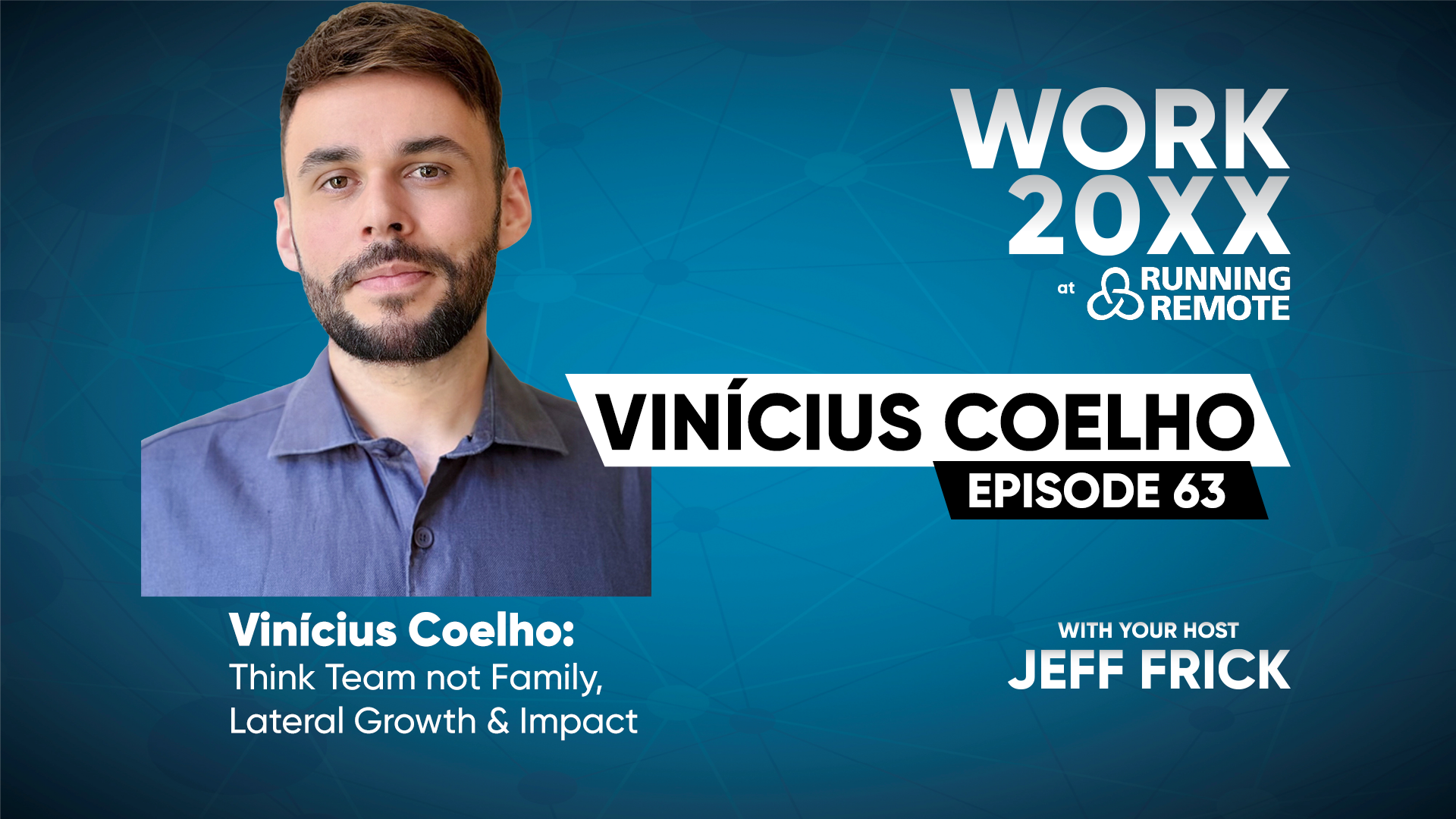
Vinícius Coelho: Know the Team, Growth and Impact | Work 20XX Ep63
Before you even think about building culture, you need to know the people you work with. You need to spend time with them... The way I see it. Think about a sports team. We signed up for this. We’re chose to do this together. We have the same goal. And if we don't, let’s align. - Vini Coelho, Time Doctor
Vinícius Coelho: Know the Team, Growth and Impact | Work 20XX with Jeff Frick Ep63 from Running Remote
Vini Coelho is making moves at Time Doctor. Promoted and adding Chief of Staff and VP Operations to his roles.
What an entertaining sit-down with Vini from Running Remote in Austin, the second year of our Work 20XX / Running Remote collaboration.
Vini brings the positive energy, and love of people to his job. It's not family, but it's the team that signed up to achieve the goal together. And in a high functioning team, individuals give more for their teamates than they do themselves. Force multiplier. Fantastic operating principle.
Please join me in welcoming Vini Coelho to the Work 20XX podcast.
Time Doctor's workforce analytics tool sits at an uncomfortable crossroads: is it surveillance or is it trust-building? Vini's answer is that the tool itself is neutral. What determines the outcome is entirely how a company chooses to use it, and whether it's turned toward empowering people or policing them.
From there the conversation moves into how Vini builds culture across a genuinely distributed team, 140 people spread across 40 countries and 24 time zones. His method starts small: know the person before you try to build anything with them. When he joined Time Doctor at 120 employees, he personally sat down with every single one, not to gather feedback for their manager, but just to understand who they were.
That same instinct shapes how he frames the relationship between people and company. Not a family, he says. A sports team. Everyone signed up for this, everyone shares a goal, and the commitment is mutual rather than familial. It's a distinction that reframes what loyalty even means at work.
The conversation closes on career growth in flat organizations, where the traditional ladder does not exist the way it used to. Vini's approach leans on transparency and lateral movement, more influence and more responsibility rather than a title change, paired with an honest acknowledgment that not everyone is headed toward becoming a director.
Underneath all of it is a throughline back to his early career in hospitality, training as a chef and working as a sommelier in a 2-Michelin-star restaurant. The lesson that followed him into HR: the job was never about the paperwork. It was always about the people.
Vinícius Coelho: Know the Team, Growth and Impact | Work 20XX with Jeff Frick Ep63 from Running Remote
Episode Transcript
Vinícius Coelho: Know the Team, Growth and Impact | Work 20XX with Jeff Frick Ep63 from Running Remote
Conversational English Transcript
© Copyright 2026 Menlo Creek Media, llc.
[COLD OPEN]
In three, two, one.
Jeff Frick:
Hey welcome back everybody Jeff Frick here from Work 20XX. We're back at Running Remote in this great collaboration with Liam and Egor and Ana and the team. And we're excited to be back because all the lessons that they talk about here at Running Remote even if you're not fully remote or even hybrid, are all great management leadership lessons that you can apply regardless of what type of organization you have. And we're excited to have our next guest. He's Vini Coelho. He is the VP People and Culture from Time Doctor. Vini, great to see you.
Vini Coelho:
Great to see you too. Thank you for having me.
Jeff Frick:
Absolutely. So Time Doctor is one of the big forces behind Running Remote for the people that aren't familiar. What's Time Doctor all about?
Vini Coelho:
Time Doctor, well, to make it simple, Time Doctor is a workforce analytics tool that helps you bridge trust between you’re remote employees and your managers. Gives you visibility and both ways, right? It gives you visibility to management. It gives you the visibility as an employee where you're spending your time. What are you're focusing at and how you can get better at work, so.
Jeff Frick:
So it sounds like it's Time, and Doctor, you're watching it close. I can see where people might misperceive it and be a little scared that say Hey, is this a surveillance application or is this a productivity application? Is this good for me? Bad for me? I imagine that might be a concern for some folks.
Vini Coelho:
It is, and it can be a concern for some folks, but also it's how the company uses the tool, right? We instruct companies, we train them, and we keep talking to them to say, you can use this in the best way possible, right? Which is how can you empower your employees to work better? And how can you empower your managers to not have to worry about those performance issues, and also for you to better understand how people work, right? Because it's not that you can manage it any different in an office environment, but in a remote environment you can only look at the outputs, right? You can only see what outcomes are happening.
Jeff Frick:
Right.
Vini Coelho:
And with the tool we can better understand how much time can people are spending into specific activities, into specific tasks. And as a leader, as a manager you can start changing that. You can see who your top performers are, and you can help your lower performers to come up as well. So at the end of the day, it's a performance tool, but it's the way that the management is going to use that tool that it makes it special or, you know
Jeff Frick:
Right. Right.
Vini Coelho:
...it can become a concern, yeah.
Jeff Frick:
And do the employees use it for their own benefit? We just were listening to the keynote from Zapier and he's talking about, you know What did I do this week and did I do the things that I intended to when I started out the week and as I'm setting up next week, you know this is all really valuable information, so Do people use it for themselves as well as for the boss keeping a track on things?
Vini Coelho:
Absolutely, and this is the way that we internally use the tool is On my team I don't track their anything they do. Is I use them and they use it on their own. We set up our tasks, we set up the activities. They will do it, they will focus on it. And what we'll do is that we review it together and understand, hey this month or this quarter, you spent too much time in specific operational tasks. Let's, you know, let's get you something different. Let's get you a different challenge here. So yeah, it's for and it's a great tool for freelancers as well to track their own time. So yeah it's both ways.
Jeff Frick:
What are some of the surprises that come out when people put it in for the first time and, you know, weren't really necessarily paying attention to where they're dividing their time and their effort And all of a sudden they’re like Whoa, this wasn't what I expected.
Vini Coelho:
The biggest one. And for me, it was when I first used it many years ago, how much time I am wasting into doing things or repetitive things. And now with AI even more so that I don't have to do it. Like I'm spending a lot of time just juggling into very specific small things that if I put an effort to focus on it let’s say first thing in the morning when I start I'll reduce that from an hour and a half a day to fifteen minutes because I'm not just like trying to fit it and squeeze in.
Jeff Frick:
Right.
Vini Coelho:
It made me understand that time management it's actually a science and a bit of an art as well.
Jeff Frick:
Yeah, yeah. It's interesting. Context switching is just brutal. Brutal for productivity.
Vini Coelho:
It is, It is.
Jeff Frick:
And I think the Atlassian report last year they said like 25% of our time is spent searching for information, which is unfortunately not surprising.
Vini Coelho:
It is. Yeah.
Jeff Frick:
So let's talk about your role. So you’re in charge of people and culture.
Vini Coelho:
Yes.
Jeff Frick:
You got people distributed. I think it's 40 some odd countries.
Vini Coelho:
40 countries at this point, yeah.
Jeff Frick:
So a lot of different cultures.
Vini Coelho:
Yeah
Jeff Frick:
How many people in the company?
Vini Coelho:
One hundred and forty.
Jeff Frick:
So that's about, what, three per country or four on average in round numbers?
Vini Coelho:
Yeah
Jeff Frick:
A lot of different cultures. So how do you build culture with so many different cultures distributed all around the world in 24 different time zones?
Vini Coelho:
There's so many ways you can do that and there's so different perspectives you can find. To me the first one, the most important is before you even think about building culture, you need to know the people you work with. You need to spend time with them. So when I joined the company the company had about 120 people when I joined. The first thing I did I sat down and I personally talked to every single person. I'm like, this is not HR giving you feedback. This is not people and culture. This is Who are you?
Jeff Frick:
Right
Vini Coelho:
Why do you like being here? What are the challenges you have? This is not me reporting back to your manager. This is me getting to know you.
Jeff Frick:
And how receptive were they? You're some new guy coming in. They don't know you from Adam.
Vini Coelho:
Everybody was freaking out. But the way I did it is that I kept doing that for three years. So every year. And now my my people and culture team, right. Everyone on the team, we do it at least twice a year. We proactively reach out to people and ask them, How are you doing? How is everything? How is your relationship with your manager going? What are the roadblocks you have? This is not for me. Like this is not about giving. Give me feedback about the company. We have other mechanisms for that. This is about I really want to get to know you. So this is how you start because HR doesn't build culture. We actually help distribute it. We help cascade it down. We create. We should be the ones creating the system for that to exist. Culture starts at the top of the company at ownership, management, but it lives within all realms of the company. HR is the one that's going to build the bridges if HR is doing the right work.
Jeff Frick:
And so how do you describe the relationship? You know, some people talk about teams some people talk about family. Some people say, no, no, no. Work is definitely not a family. You know, family doesn’t lay-off family.
Vini Coelho:
Absolutely
Jeff Frick:
So how do you kind of how do you frame the relationship with the individuals within the company and their relationship with the company?
Vini Coelho:
Again, different ways that you can put it. The way I see it. Think about a sports team, right. We're all colleagues we’re all together in this. We all have the same goal. And if we don't, let’s align, why we don’t, right? Not a family. Absolutely not. No.
Jeff Frick:
Right.
Vini Coelho:
Family is a different thing. Super important. It has its own pedestal, its own place. This is more like a sports team. This is something that we chose to do together, right. We signed up for this. And every day as we commit as you clock into work, right?
Jeff Frick:
Right
Vini Coelho:
...as you show up to work, you commit to do it. And it's about that commitment level, right? So it's not I'm not trying to see if you're more committed than the other person. What I'm trying to see is do we have the same agreement? Are we on the same page?
Jeff Frick:
Right. And a really important part of teams all teams is people don't do it for usually for the boss. They do it for their teammates.
Vini Coelho:
Yep
Jeff Frick:
And people will do more for their teammates than they even will for themselves. So what are some of the things that you do to to strengthen that relationship between the team members? Because again, they're all distributed. They're not sitting with each other, right?
Vini Coelho:
Yeah. I think we can think of company-wide initiatives. So I do have someone which is a people experience specialist or, you know used to be more focused on engagement. But now the experience side. We're constantly communicating. We're constantly making people talk to each other through silly things and more important activities. People got used to see that HR People and Culture at Time Doctor. People got used to see that we're always there. It doesn't matter where you're going to see someone from the team there, right? So that's the first thing. The second is as a distributed company we don't want silos, but we understand that they're going to have some sort of silos, so within those tight knit close communities is how do you make sure that they get that experience that they have together? Give an example. Specific country that we have 30 people working there. They are their own little community. So how do I start bringing people from other areas together to them and start doing activities? Right. So we put a focus on team level building. So engineers building, team building or product managers, marketing teams, salespeople, right. And then we cross functionally try to do that as well. So there is a conscious effort of always proactively talking to people.
Jeff Frick:
Yeah
Vini Coelho:
So we basically know that we have to steer the conversation as HR. It's part of the job when it that level distributed and we are mostly async, but we're not like companies that have zero meetings, right? We do have sequence of meetings. We do get together on call. We are sync’d together it's a huge challenge to do it, but it's part of the way we've built our culture. It's not to say that it's wrong to do it 100% async or 100% sync, but the way we found that our culture will be built better is that we cascade it down remotely and async. But we implement it we check with people sync. So like we get with them on a call we look at their faces and really like meaningfully engage.
Jeff Frick:
Right. And you've talked about being culture first. So clearly you've made a big investment and you're very intentional at all these steps and processes that you guys put into place to make sure that's happening. And how does that impact in terms of the engagement of the company when you do do surveys and do get a feel for people's engagement? Because one of the things I think is the key is Can you get marginal effort out of people? You know, are they bought in and are they pulling hard or are they just pulling? And the difference there can be giant.
Vini Coelho:
It is, it is. From experience and from what I see at Time Doctor, and I would say Time Doctor has been my lab as well because I've been testing so many things there. And it's been a lot of fun. It's a fun ride and it's You have to be intentional about what you set up and what you propose yourself to do because then that's the only way that others will believe you. And they kind of follow your lead, right?
Jeff Frick:
Right.
Vini Coelho:
So the biggest way we found over the years that will make sure people understand what we're trying to do, is that we keep everything as transparent as possible. This is why the documentation process and using the tools or that system it works right. We have a cadence of I communicate here. I store here. I act here. I deliver here. Right, so something that I spoke last year Running Remote about with in a panel a system that is, it's a cycle, right. It's cyclical. It keeps happening for everything.
Jeff Frick:
Right.
Vini Coelho:
Because then it builds that sense of continuity. You know, routine. A routine is hard when you work remotely right because you can just stop what you're doing and then take a break and then come back and then do something else, right? It's part of the gig. Routine is important. But instead of a time routine a process routine so people get used and if you're comfortable, they feel more at ease about work, right? That's when I open up. That's when I get them loose enough to talk about engagement. That's when I get them loose enough to really get them to speak their truth about things that are uncomfortable to them, right. And I think that It’s a bit of a it's not easy, right?
Jeff Frick:
Right.
Vini Coelho:
But with the right intent with the right effort eventually we got it wrong so many times we got it right. So
Jeff Frick:
I love that
Vini Coelho:
It's a system, but yeah.
Jeff Frick:
So another topic that's come up here is careers and career progression. And at the same time a lot of the organizations here are relatively flat. You know, there's not a lot of layers and hierarchies from which to move up. How do you kind of help manage that for people when you've got high performing folks, they want to develop and grow their careers, but maybe there isn't the traditional, you know, step, step, step up through 27 layers of management in terms of a career progression. How are you thinking of career progression? How are you helping your people think about growing, developing, changing, not necessarily hierarchical, but more broader and developing?
Vini Coelho:
Absolutely. This is so important, right. We are at a crossroads in time that people still come from the environment that if you need to grow, if you're going to grow, you're going to grow vertically and most likely into management. Right?
Jeff Frick:
Right.
Vini Coelho:
People management and vertical growth is what matters because that's the reality we came from, why This is how work relations happened for the past 70, 80 years. We're now seeing that especially with the advent of AI and everything happening, it's different, right. And organizations are we at Time Doctor as well. We are becoming flatter. We're not adding as many people as we used to for functions. We are empowering our current people to do more with technology, right. So the first thing we do is to be transparent about it. Hey, the way you're going to grow is the way that makes sense to you. Do you want to believe, and do you think that vertical growth is the only growth? It might not be possible here. Being transparent. And it's hard because I'm not saying, hey, that's what you want, so I’m going to fire you. No. That's what you want. Let me show you a different thing. So how do you get more responsibilities lateral growth right. So I work in support. Right? I am a product specialist. So how can I be closer to product? How can I be closer to customer success? How can I do things that will deepen the influence I have or the reach that I have in the company? So I become more relevant in that, and that opens up opportunities. I learn more about it and then there's a different role, so yeah, you might change departments or you might change the scope of the role, kind of staying in the same line but with compensation growth with, you know, your ability to influence the business as well, becoming more strategic. But you're not going to grow from a coordinator to a manager to a director necessarily, not everyone is going to go through that experience.
Jeff Frick:
Right, right.
Vini Coelho:
And we are transparent. We have to be
Jeff Frick:
Right. So I want to shift gears a little bit and talk about your background because you come at this from I don't know, different place non-traditional place, different place.
Vini Coelho:
Yep
Jeff Frick:
And that's hospitality, Which is really interesting because when I first started talking about future of work and we started talking about, you know different types of activities that need different types of resources, I started to think Wow, this kind of sounds like a a nice resort hotel. I wonder if that's why they have off sites at nice places that have all these resources.
Vini Coelho:
Yep
Jeff Frick:
And you come from that world. What type of learning do you get to bring over and what do you see and leverage that you learned back in your hospitality days to really help build better cultures in this organization?
Vini Coelho:
Honestly, everything. It's an ‘everything’ thing. But let me tell you what's the most important about it. In hospitality well, I went to to a hotel school and I also studied culinary. I wanted to be a chef. I wanted to have my own restaurant and have Michelin stars and all that. And I did have the experience to work in the industry, and it was lovely. But it I wanted more because what I realized is the key thing that was the bridge between that role to the role I have today is that I like taking care of people. If you're going to be good at HR if you're going to be meaningful at HR. You don't love paperwork. You love people. It's about the people. So that's that's where it starts. So to me is when I was a sommelier in a 2 Michelin star restaurant back in many, many years ago, what was my goal? Was to serve the best experience to the guests, right. Now as an HR professional, is to allow people to be their better selves in their work environment is to allow them to build a career in the company to allow them to build, you know, I No one nowadays or very rarely it's going to stay 20 years in the company. Those We're not in those that age anymore.
Jeff Frick:
Right, right.
Vini Coelho:
But I want your passage here, your time be it a year or ten so you can grow, right, so you can feel at ease. So you can feel that you belong somewhere, that you can be yourself. And to me, honestly if HR is not doing that you don't need hospitality background to do it. But if you're not doing that, you're doing it wrong.
Jeff Frick:
Yeah, I love that. The place to grow and also just the recognition and the acknowledgment that they are probably not it's probably not their last job just as a as pure statistics, right.
Vini Coelho:
Yeah, absolutely.
Jeff Frick:
It’s probably not their last job. But that's okay.
Vini Coelho:
Yep
Jeff Frick:
And give them the conditions to grow I think that is awesome. Well Vini, super excited to sit down with you. Thanks for bringing us back. Second year in a row here at Running Remote It's a great community. The vibe and the buzz and the warmth of the people and the sharing is really really fun to participate in.
Vini Coelho:
It is. It's quite special. Thank you for having me. I'm really thrilled.
Jeff Frick:
Absolutely. All right. He's Vini, I’m Jeff. You're watching Work 20XX from Running Remote in Austin, Texas. Thanks for watching. Thanks for listening on the podcast. Catch you next time. Take care. Bye bye.
[COLD CLOSE]
Jeff Frick:
Perfect. That's great. Thank you.
Vini Coelho:
Thank you.
Jeff Frick:
Love your enthusiasm.
—-----------------------------
Vinícius Coelho: Know the Team, Growth and Impact | Work 20XX with Jeff Frick Ep63 from Running Remote
Conversational English Transcript
© Copyright 2026 Menlo Creek Media, llc.
Vinícius Coelho
Links & References
Profile
LinkedIn: https://www.linkedin.com/in/vncoelho/
Company
Time Doctor (workforce analytics platform): https://www.timedoctor.com
Time Doctor — About: https://www.timedoctor.com/about
Time Doctor — Wikipedia (company background, founding, 2025/2026 awards): https://en.wikipedia.org/wiki/Time_Doctor
Running Remote — Conference
Running Remote (official site): https://runningremote.com
Time Doctor's Running Remote hub: https://www.timedoctor.com/running-remote
Running Remote 2026 press release, 9th year, April 27–29, Fair Market, Austin: https://www.newswire.com/news/time-doctors-running-remote-conference-returns-for-its-9th-year-with-22769031
Vini's Prior Running Remote Appearances
Running Remote April 2025 (Austin) — full speaker/session roster including Vini's panels: https://runningremote.com/conferences/running-remote-april-2025/
Panel: Rapid-Fire Bites: Team Engagement Lessons from Top Remote Leaders
Panel: Lessons From Remote Culture Champions (alongside Chris Patrick/Zapier, Sarah Walker/The Long-Term Stock Exchange, Erin Grau/Charter)
Running Remote 2026 speaker announcement: https://www.facebook.com/RunningRemote/photos/-meet-our-next-running-remote-2026-speaker-vin%C3%ADcius-coelho-vp-of-people-culture-/890432860037164/
This Episode
Vinícius Coelho: Know the Team, Growth and Impact | Work 20XX with Jeff Frick Ep63 from Running Remote
---
Disclaimer and Disclosure
All products, product names, companies, logos, names, brands, service names, trademarks, registered trademarks, and registered trademarks (collectively, *identifiers) are the property of their respective owners. All *identifiers used are for identification purposes only. Use of these *identifiers does not imply endorsement. Other trademarks are trade names that may be used in this document to refer to either the entities claiming the marks and/or names of their products and are the property of their respective owners.
We disclaim proprietary interest in the marks and names of others.
No representation is made or warranty given as to their content.
The user assumes all risks of use.
© Copyright 2026 Menlo Creek Media, llc.


Jeff Frick has helped literally tens of thousands of executives share their stories. In his latest show, Work 20XX, Jeff is sharpening the focus on the future of work, and all that it entails.