Gianna Driver: How You Treat the Waiter, Humans First, Employees Second | Work 20XX Ep60


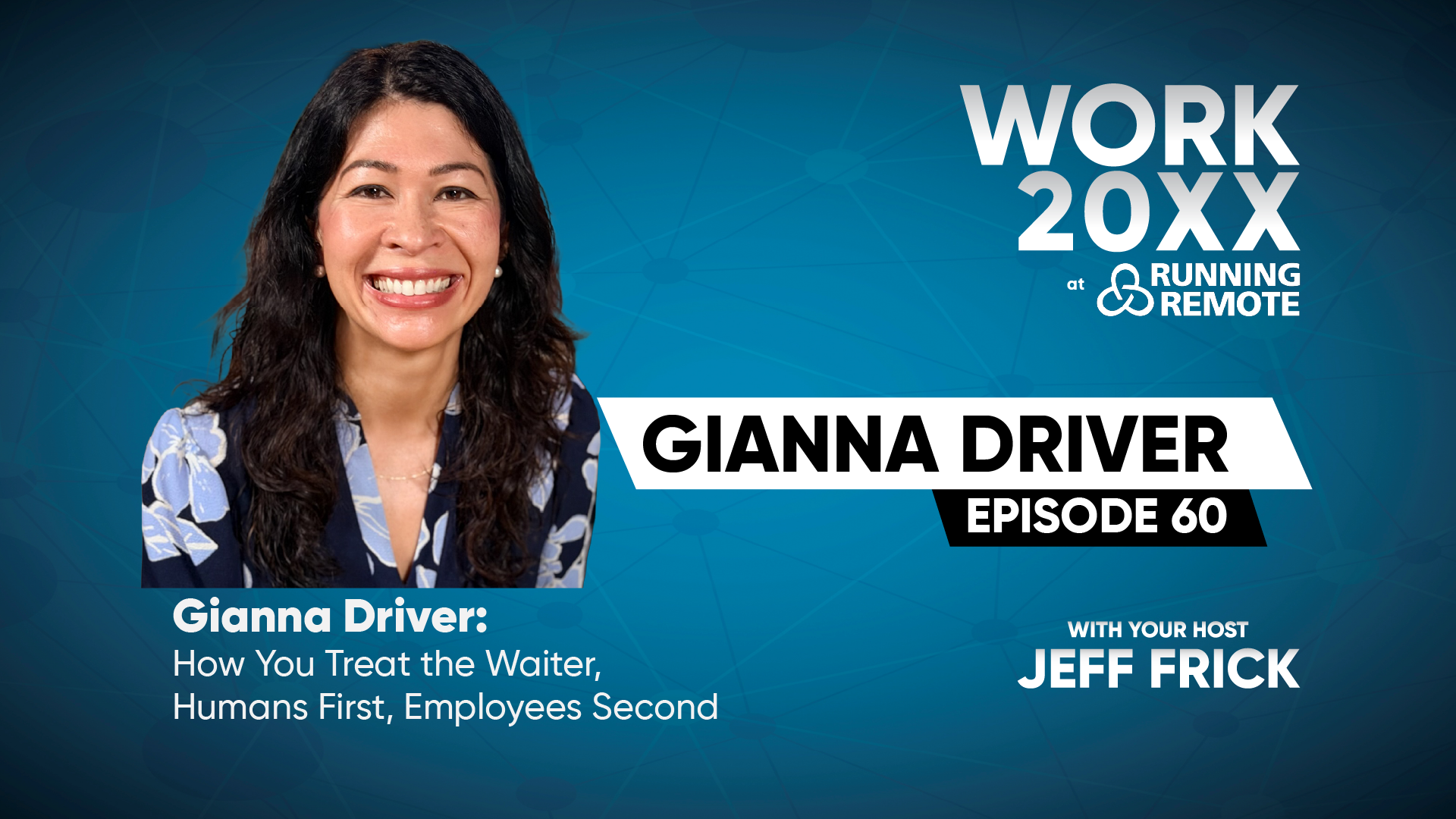
Gianna Driver: How You Treat the Waiter, Humans First, Employees Second | Work 20XX Ep60
"I predict — you heard it first — those organizations doing layoffs under the guise of AI replacing these jobs are going to see a boomerang effect where they need to rehire a lot of that talent, because they've over-cut. AI can do a lot, but AI can't do everything." - Gianna Driver
Gianna Driver joined me at Running Remote 2026 in Austin, fresh into her new role as Chief People Officer at One Workplace — a company that designs the physical environments where people do their best work. Which, at a conference built around remote and distributed teams, might sound like a non-sequitur. It isn't. Whether you're fully remote, hybrid, or somewhere in between, you still gather. The question is whether you're intentional about what happens when you do.
The conversation went deep fast. Gianna's philosophy isn't abstract — it's rooted in a childhood spent on the other side of privilege, a mother who emigrated as a mail-order bride, and a firsthand understanding of what it means to be unseen. That's where her humans-first leadership comes from. And it shows up everywhere: in how she thinks about physical space as a culture tool, in her insistence that mistake-making be normalized, in the waiter test she uses for critical hires, and in her refusal to let the political backlash against DEI become an excuse to abandon the practices that science — and basic decency — have long supported.
She also made a prediction. On the record. The companies doing AI-driven layoffs are going to over-cut, realize AI can't do everything, and scramble to rehire the talent they let go. Write it down.
Please join me in welcoming Gianna Driver to the Work 20XX Podcast.
Editor's Note: Recorded May 2026 at the Running Remote conference in Austin, Texas. Special thanks to Liam, Egor, Ana, and Team Running Remote.
Gianna Driver: How'd You Treat the Waiter, Humans First Employees Second | Work 20XX podcast with Jeff Frick from Running Remote 2026 Austin
Episode Transcript
Coming Soon Gianna Driver: How You Treat the Waiter, Humans First, Employees Second | Work 20XX Podcast with Jeff Frick Ep60
English Transcript
© Copyright 2025 Menlo Creek Media, llc.
---
Cold Open
In three, two, one.
**Jeff Frick:**
Hey, welcome back everybody. Jeff Frick here coming to you from Austin, Texas. Yeah, Work 20XX is back on the road at Running Remote. We were here last year and we love to come to this show because even though it's called Running Remote, most of the lessons are just general management, leadership, and the best way to do things. So there's a lot here that's applicable all over the world, and really the focus keeps changing and changing and changing. And it's all about AI, AI, AI. Probably no surprise to you, certainly not to me. But we're excited to have our next guest. She's Gianna Driver, the Chief People Officer at One Workplace. Gianna, great to see you.
**Gianna Driver:**
Hi Jeff. Great to be here. Thanks for having me.
**Jeff Frick:**
Absolutely. So I heard before we turned the lights on, this is your first time at Running Remote. Love to get your impressions of the vibe, the community.
**Gianna Driver:**
I am loving it. I don't think I've met anyone here who hasn't been warm and kind and authentic and just so welcoming. So super, super jazzed to be here.
**Jeff Frick:**
Awesome. So you recently took a new position at One Workplace. So give people the kind of 101 on what One Workplace is all about and why you're excited about the opportunity.
**Gianna Driver:**
Yeah, well, so at One Workplace, what we do is we create environments—in-person environments—where people can thrive and do their best work. And I was super excited about that because I believe physical space has a lot to do with our employee experience. Physical spaces can bring out our innovation, our creativity, and just, it can make us feel happy and joyful. So super excited to be here.
**Jeff Frick:**
So how does that dovetail with remote? If somebody’s listening in, they might say, "Mmm, that sounds like a little bit of a non-sequitur." How does the workplaces and workplace design connect with remote work?
**Gianna Driver:**
Well, we're seeing more and more companies have return-to-office mandates, and/or companies that are remote-first are still being very intentional about bringing people together with some level of frequency. Because at the end of the day, we have to acknowledge we are humans first and employees second. To honor that human connection, we gather. And so, depending on the size of company and the types of office spaces, it's really important that organizations are very strategic and intentional about the environments where they have people gather. And that's where One Workplace comes in.
**Jeff Frick:**
Awesome. So you've said before, culture is not something that's put on people, it’s something they build together, and clearly together in spaces—especially around social connection and the reason that people do gather, which is not to get on a Zoom call and not to do email, hopefully.
**Gianna Driver:**
Yes.
**Jeff Frick:**
I wonder if you can share how you think about influencing people to build a better culture together?
**Gianna Driver:**
Well, culture is something that I think if we are not intentional about, culture is going to happen anyway. So we might as well be very intentional about the type of culture we want to create. If we're the type of organization that values innovation and having people brainstorm and ideate together, it's important that our workspaces reflect that. That could mean movable walls, let's say—walls that are able to help create an environment on one particular day. But then the next day, if you have a training session or an onboarding session, you might need to reconfigure that space differently. Making sure the ancillary places where people sit and chit-chat, whether those are cafes or just sort of waiting areas, are also emblematic of our values, is really important.
**Jeff Frick:**
So I'm curious if you've seen, as we've seen kind of the evolution of space, especially with more distributed work, and maybe people aren't coming in every day, but they're coming in for special purposes, that it seems like a lot of the stuff they’re looking for smells like, looks like, feels like hospitality. And you're like, "Well, of course." That's why you have great offsites is you go to a nice place that's got all these facilities, all these amenities, all these services. Are you seeing people—either in a shared environment maybe within a building or a shared ecosystem—bringing in, you know, a podcast studio or different kinds of shared resources and assets that aren't just rows of desks for people to sit?
**Gianna Driver:**
Yes, all of the above. And actually, one of the things that I've realized and learned is the days of having cube farms are long gone. Thankfully, Jeff.
**Jeff Frick:**
Thankfully.
**Gianna Driver:**
Thankfully. I don't know anyone who enjoyed sitting in rows and rows of cubes. And, you know, I think we have the tech space to really thank for this—like a couple of decades ago in Silicon Valley, where we're both based, we saw companies like Google and Facebook, now Meta, start to get really creative with their spaces. And so companies like One Workplace continue that trend where it is really fun and innovative and colorful, and not the cube farms that we've seen in the past.
**Jeff Frick:**
My first day at Intel, you got your assignment, and I was at RNB, the main building, the Robert Noyce Building. It's like going to the Disneyland parking lot—your desk is at pole G4, right? Your printer is at C2, and they were like six-foot-high cubes. You know, you gopher
**Gianna Driver:**
Yeah.
**Jeff Frick:**
you gopher over the top. No, that was not good. Not good.
**Gianna Driver:**
Yeah, I remember that too. And actually, one of the interesting things about workspace is you can have printers or water coolers in really creative spaces that are almost forcing functions for people to have these casual encounters with one another. And ironically, that actually starts to build social connection between folks.
**Jeff Frick:**
That’s great. Put the printer in a nice space for people to hang out instead of the water cooler, right?
**Gianna Driver:**
Yeah.
**Jeff Frick:**
That's awesome. Okay, so one of the reasons I love this conference, like we said in the open, is that a lot of the behaviors and the management activities that made distributed people successful at distributed work are good for all business. And one of those characteristics is taking risks. And how does management respond when you take risks? You can have a very specific kind of point of view on mistakes and celebrating mistakes, and really thinking of mistakes not as bad things. But I wonder if you can share kind of your philosophy on mistakes, how they should be amplified or celebrated, and where does that come from?
**Gianna Driver:**
Yeah, well, so there's a quote that I like that says we miss 100% of the shots we never take. Said differently, I think a lot of times people don't take the shot. They don’t try to take the shot because they're afraid of failure. And I think it's really important for leaders to create environments where employees are ambitious and they're striving. Guess what—when you strive and you try, you're not always going to win. You're not always going to get to the goal. When you look at a child, do you know how many times a child falls before they learn how to walk? It’s something like 38 or something like that is what I've read.
**Jeff Frick:**
Okay, there's a number.
**Gianna Driver:**
There's an actual number that people very, very smart have studied and looked at. I want to do attribution, but I forget which place had that study. But the point is, mistake-making should be normalized if we truly want to have high-performing, highly productive teams and workforces. Leaders should start to embody that themselves in celebrating mistakes. Now, we want to make the mistakes quickly, we want to make them cost-effectively, and we want to learn from them. But I would say organizations that have cultures of fear where people are afraid are actually missing out on folks being as productive as they could otherwise be.
**Jeff Frick:**
Yeah. My modification to that saying is, if you're not making mistakes, you're not trying hard enough.
**Gianna Driver:**
I agree.
**Jeff Frick:**
Right? You’re not pushing the edges. If everything‘s going smoothly, you know, you're not really kind of getting out there on the edge.
**Gianna Driver:**
Yeah, I agree. 100% agree with you.
**Jeff Frick:**
It seems in a lot of the hiring processes today that we’ve kind of gone to—instead of people to people, it feels like it's machine to machine, right? The machines are evaluating the resumes. People are trying to game the front end and keyword stuff and this, that, and the other. And you had a really interesting thing I read about how you partly evaluate talent, and it's: how do they treat the receptionist?
**Gianna Driver:**
Yes.
**Jeff Frick:**
How do they treat the person that scheduled the meeting?
**Gianna Driver:**
Yes.
**Jeff Frick:**
And that comes from a very special place, and it's very meaningful. Where does that come from, and why do you think that this is such an important factor as to whether you should or should not bring that person into the company?
**Gianna Driver:**
Yeah. I want to help organizations build companies filled with humans who are values-oriented, who are kind and respectful. One of the ways that we can assess that is seeing how people treat those for whom they have no vested interest—people who have nothing in terms of a raise to give them or anything like that. You ask where this comes from. This comes from my childhood. I grew up in a pretty impoverished place. My mother was a mail-order bride when she emigrated to the US, and I've been on the other side of the life of privilege I live now. And I have to say, at the end of the day, we are humans. There is a similarity no matter what clothes we wear, the cars we drive, or the positions we hold.
**Jeff Frick:**
Right.
**Gianna Driver:**
We are human beings and there is value in our thoughts, our perspectives, and our lived experiences. And I want to create environments where we value all of the voices in our organization. And so, a lot of times you’re right—for very, very critical hires, I like to take people outside of the office. Take them to lunch, take them to dinner, and see how they treat the wait staff. I’ve been in one environment where we had a Chief Revenue Officer we were hiring, and he'd interviewed well. This was toward the end of the process, and we went out to dinner. Well, guess what? The server got his order wrong. And yes, it was the server's human error.
**Jeff Frick:**
I was going to ask, did you set the server up on purpose? Give him something
**Gianna Driver:**
No, I didn’t!
**Jeff Frick:**
give him something wrong and see?
**Gianna Driver:**
That would have been good! That’s next level. *(laughter)* But this candidate treated him incredibly poorly. I mean, he was shamed and blamed, like all of these things. And that told me about his character.
**Jeff Frick:**
Yeah.
**Gianna Driver:**
We ended up not making this hire. There were a few other red flags in the process, but for the most part, he was one of our finalists and had interviewed very well.
**Jeff Frick:**
Right.
**Gianna Driver:**
But I share that because it's important that we create teams where mistake-making is okay, and where people treat each other with kindness and respect.
**Jeff Frick:**
Right, no, I love it. And so then to dovetail off of that, let's talk a little bit about DEI. Unfortunately, you know, a couple of years ago everyone was all good with it because we know that a variety of perspective, a variety of life experiences, you know, just a variety of points of view is going to help everyone get to a better answer. Because we just can't see what we don't know, and people have different perspectives. Clearly, you know, that was kind of sh on by the current administration in Washington, and we've seen some CEOs actually pull back pretty aggressively, which is very depressing. But, you know, to look at you, to look at, you know, this concept of the "Lost Einstein," which I think is so powerful—which is, you know, there's a ton of smart people out there. Not everybody gets the same opportunities, and not only for education, but even nourishment and support and so many things. Talk about why you still embrace that and why it isn't just a good thing, but it actually has, like many things, great business benefit and it's the right thing to do.
**Gianna Driver:**
Yeah, well, I guess a few things with that. And I have to preface and say, Jeff, thank you for going to vulnerable and hard places because this is a conversation that I think needs to happen. A lot of people are thinking about it. A lot of people are having conversations about this behind closed doors. And as someone who values communication, openness, and transparency, I'm glad that you're bringing this to light and asking very directly.
So what I will say to that is, regardless of what we call this—I know that DEI is a triggering word. I know that ERGs *(Employee Resource Groups)* are also something that's kind of fallen out of vogue. At the end of the day, inclusivity and diversity matter. We know from science that teams who are comprised of diverse folks—folks who come from different lived experiences, different religious and ethnic backgrounds
**Jeff Frick:**
Right.
**Gianna Driver:**
end up coming up with better solutions, because they're thinking about this in ways that someone who hasn't had those experiences is just unable to see those perspectives. And so I think as leaders, it’s really important that we still are very intentional about creating—creating inclusive and diverse teams. If the words are triggering, let's use different words. But the spirit of what we want to do must continue for us to be successful.
**Jeff Frick:**
Yeah. And it results in better outcomes. I mean, it results in better outcomes. We joke all the time with my wife, you know, we'll go to the farmers’ market together, and we'll come home from the farmers' market together, and we'll talk about what we saw, heard, and experienced at the farmers' market, and it might be completely different. And here we were together at the same place, and we just experienced something different. So it's so important to get variety of experience into that process.
**Gianna Driver:**
100% agree with you.
**Jeff Frick:**
I was going to ask you about your Sonic days, but I think it's funny though, because Liam Martin yesterday had a really interesting statement. He said, "I won't hire anyone that hasn't at some point in their career worked at, been in the military, retail, or fast food, because they've had a crappy job. They know what a crappy job is." You've had a crappy job. But more importantly, how do you keep the humanity in this world that feels like it’s just machine-to-machine on the application process and everything? How should candidates cut through? How do you cut through to find the people behind this sea of applications?
**Gianna Driver:**
Well, so a few things to that question. I am a believer in AI and I do love technology, so I want to preface and say I definitely think there's a place for AI to enable humans to do what humans do best and to move faster, quicker, more data-informed—all of that stuff. So I absolutely agree and want those things.
At the same time, when it comes to service, when it comes to sifting through a plethora of applications, I think it is important that we continue to have a human touch in what we do—that we have phone calls and in-person meetings when possible, because there's so much more information that's exchanged when you meet someone in real life.
**Jeff Frick:**
Right.
**Gianna Driver:**
That is how we have evolved for millennia. And I think that attempting to come up with a world where we live in a machine-to-machine environment is ultimately going to implode and be unsuccessful. So I'm very excited about organizations and events like this that bring people together for human-to-human connection. We can still have AI, we can still have technology assist us, but it should be in an assisting and an enabling function, not a decision-making, final-say function.
**Jeff Frick:**
Yeah, that's great. And it is weird. It feels like there's kind of a bifurcation in the world between those companies that believe it's people with AI and are using the savings and the efficiency to basically repurpose and reposition people—I forget who just announced today, "no layoffs, we're restaffing"—versus those that just seem to be wanting to replace people as fast as they possibly can. And it's going to be interesting to see how it shakes out.
**Gianna Driver:**
I predict, this is my prediction. You heard it first here on your podcast.
**Jeff Frick:**
Write it down. All right, I’m ready. *(laughter)*
**Gianna Driver:**
I think that in a few years, those organizations that are doing layoffs under the guise of "AI is replacing these jobs," I think they're going to see this boomerang effect where they need to rehire a lot of that talent because they've over-cut. Because they realize, "Oh wow, AI can do a lot, but AI can't do everything."
**Jeff Frick:**
Right.
**Gianna Driver:**
And guess what? We need humans to be upskilled and reskilled because there's still a need and a place for them here in our organization. That is my prediction. I also envision a world down the road where, similar to ATMs—no one talks about ATMs anymore, but they did back in the day when they were new. There was a lot of fear around them.
**Jeff Frick:**
Right.
**Gianna Driver:**
I think we will eventually get to a place—could be five years, could be ten years, I'm not really sure—where it's not so much fear-based around AI. I think we're going to find a way to live with AI. That is my hope and my prediction.
**Jeff Frick:**
Yeah. All right. Well, hopefully, we’ll have more success than we did with social media and some of the other stuff, but that's a conversation for another day.
**Gianna Driver:**
That’s true.
**Jeff Frick:**
All right, well Gianna, thanks for taking a few minutes to come by. It's been a real treat to get to know you, and thanks for coming down to Running Remote.
**Gianna Driver:**
Yeah, likewise. Thanks for having me.
**Jeff Frick:**
Absolutely. All right. She's Gianna, I'm Jeff, you're watching Work 20XX from Running Remote. Thanks for watching, thanks for listening. See you next time. Take care. Bye-bye. *(clapping)* Awesome.
--
Gianna Driver: How You Treat the Waiter, Humans First, Employees Second | Work 20XX Podcast with Jeff Frick Ep60
English Transcript
© Copyright 2025 Menlo Creek Media, llc.
━━━━━━━━━━━━━━━━━━━━━━━━━━━━━━━━━━━━━━
LINKS & REFERENCES — Gianna Driver
Work 20XX at Running Remote 2026 · Austin, TX
━━━━━━━━━━━━━━━━━━━━━━━━━━━━━━━━━━━━━━
🔗 CONNECT WITH GIANNA DRIVER
• LinkedIn → https://www.linkedin.com/in/gianna-driver-6183391/
• One Workplace → https://oneworkplace.com
━━━━━━━━━━━━━━━━━━━━━━━━━━━━━━━━━━━━━━
📰 RECENT NEWS
━━━━━━━━━━━━━━━━━━━━━━━━━━━━━━━━━━━━━━
• [Apr 2026] One Workplace names Gianna Driver Chief People Officer
→ https://hrtoday.in/one-workplace-appoints-gianna-driver-as-chief-people-officer/
• [Oct 2025] Gianna Driver joins OpenTable as Chief People Officer
→ https://hrtoday.in/gianna-driver-joins-opentable-as-chief-people-officer/
• [Jul 2024] Gianna Driver joins Lattice as Chief People Officer
→ https://lattice.com/blog/gianna-driver-joins-lattice-as-chief-people-officer
━━━━━━━━━━━━━━━━━━━━━━━━━━━━━━━━━━━━━━
🎙️ PODCAST APPEARANCES (Latest → Oldest)
━━━━━━━━━━━━━━━━━━━━━━━━━━━━━━━━━━━━━━
• [Jul 2025] Simpplr · Cohesion Podcast
"Is Employee Engagement Over?"
→ https://www.simpplr.com/podcasts/audio/is-employee-engagement-over/
• [Apr 2025] PeopleForward Network · Working Forward
"AI and the Future of Employment"
→ https://workingforwardpodcast.libsyn.com/ai-and-the-future-of-employment-with-gianna-driver
• [Aug 2024] Love and Leadership Podcast
"Transforming Workplace Culture" (as CPO at Lattice)
→ https://www.loveandleadershippod.com/transforming-workplace-culture-with-gianna-driver-cpo-at-lattice/
• [Aug 2024] The Empathy Edge · Maria Ross
"The Link Between Diversity, Inclusivity, and Performance"
→ https://red-slice.com/the-empathy-edge/gianna-driver-the-link-between-diversity-inclusivity-and-performance/
• [Feb 2024] The Leadership Puzzle · Evolve HRS
"Leading the Next Generation"
→ https://www.evolvehrs.com/podcast/v/leadership-puzzle-gianna-driver-exabeam-6bj8s
• [Apr 2022] Work and Life with Stew Friedman · Wharton School
"From Women's Shelter to Chief Human Resources Officer" (Ep. 226)
→ https://www.workandlifepodcast.com/blog/gianna-driver-from-womens-shelter-to-chief-human-resources-officer
→ https://podcasts.apple.com/us/podcast/ep-226-gianna-driver-from-womens-shelter-to-chief-human/id1175869621?i=1000555951039
• The Employee Onboarding Podcast · Process Street
"Executive Onboarding" (Ep. 4 — recorded during her time at Exabeam)
→ https://www.process.st/employee-onboarding-podcast-episode-4/
━━━━━━━━━━━━━━━━━━━━━━━━━━━━━━━━━━━━━━
🎤 SPEAKING & CONFERENCE APPEARANCES
━━━━━━━━━━━━━━━━━━━━━━━━━━━━━━━━━━━━━━
• [2026] Running Remote · Austin, TX
Guest interview — Work 20XX (this episode)
• [2024] Transform Conference
Speaker (as CHRO at Exabeam)
→ https://register.transform.us/2024/speaker/981818/gianna-driver
• CultureCon (multiple years)
Speaker / attendee — quoted extensively on culture-building
→ https://culturecon.com
━━━━━━━━━━━━━━━━━━━━━━━━━━━━━━━━━━━━━━
✍️ EDITORIAL & RECOGNITION
━━━━━━━━━━━━━━━━━━━━━━━━━━━━━━━━━━━━━━
• Forbes Human Resources Council — Contributing Writer
• HR Executive Magazine — Named to Top 100 HR Tech Influencers (2022)
• Frequently quoted in The Wall Street Journal, Forbes, US News & World Report, and Insider
• Transform — Spotlight Series Profile (Oct 2024)
→ https://transform.us/articles/spotlight-gianna-driver/
━━━━━━━━━━━━━━━━━━━━━━━━━━━━━━━━━━━━━━
📚 BACKGROUND & CAREER TIMELINE
━━━━━━━━━━━━━━━━━━━━━━━━━━━━━━━━━━━━━━
• 2026–present Chief People Officer · One Workplace (Santa Clara, CA)
• 2025–2026 Chief People Officer · OpenTable
• 2024–2025 Chief People Officer · Lattice
• ~2021–2024 CHRO · Exabeam
• 2019–~2021 Chief People Officer · BlueVine
• Earlier roles VP HR at Aristocrat (gaming), Actian, Talend, Balsam Brands, Playstudios
• Pre-HR career Founder, GIANNA Fair Trade (eco-fashion / artisan home décor, ~5 yrs)
Named to Inc. Magazine's "30 Under 30" for this venture
• Education B.S. Management & Entrepreneurship, The Wharton School, University of Pennsylvania
(Attended on a full scholarship; completed Prof. Stew Friedman's Total Leadership class)
━━━━━━━━━━━━━━━━━━━━━━━━━━━━━━━━━━━━━━
🔗 ABOUT THIS SHOW
━━━━━━━━━━━━━━━━━━━━━━━━━━━━━━━━━━━━━━
Work 20XX is produced by Menlo Creek Media.
Host/Producer: Jeff Frick
Work 20XX Website - Transcripts and Show Notes → https://www.work20xx.com/episode/gianna-driver-how-you-treat-the-waiter-humans-first-employees-second-work-20xx-ep60
Work 20XX on Substack → https://work20xx.substack.com/
Work 20XX on YouTube - https://www.youtube.com/watch?v=SlkZtMMnsmo&list=PLZURvMqWbYjmmJlwGj0L0jWbWdCej1Jlt
Work 20XX on Spotify - https://open.spotify.com/episode/3Ezsn78NGq3jqc8MGoLtXo?si=44d7d123e2414755
Work 20XX on Apple Podcasts - https://podcasts.apple.com/us/podcast/gianna-driver-how-you-treat-the-waiter-humans-first/id1605790876?i=1000771750598
LinkedIn → https://www.linkedin.com/in/jefrick/
Running Remote → https://runningremote.com
------
Disclaimer and Disclosure
All products, product names, companies, logos, names, brands, service names, trademarks, registered trademarks, and registered trademarks (collectively, *identifiers) are the property of their respective owners. All *identifiers used are for identification purposes only. Use of these *identifiers does not imply endorsement. Other trademarks are trade names that may be used in this document to refer to either the entities claiming the marks and/or names of their products and are the property of their respective owners.
We disclaim proprietary interest in the marks and names of others.
No representation is made or warranty given as to their content.
The user assumes all risks of use.
© Copyright 2025 Menlo Creek Media, llc.


Jeff Frick has helped literally tens of thousands of executives share their stories. In his latest show, Work 20XX, Jeff is sharpening the focus on the future of work, and all that it entails.