Nadia Vatalidis: Extreme Async, Unguarded Feedback, Career by Initiative | Work 20XX Ep59


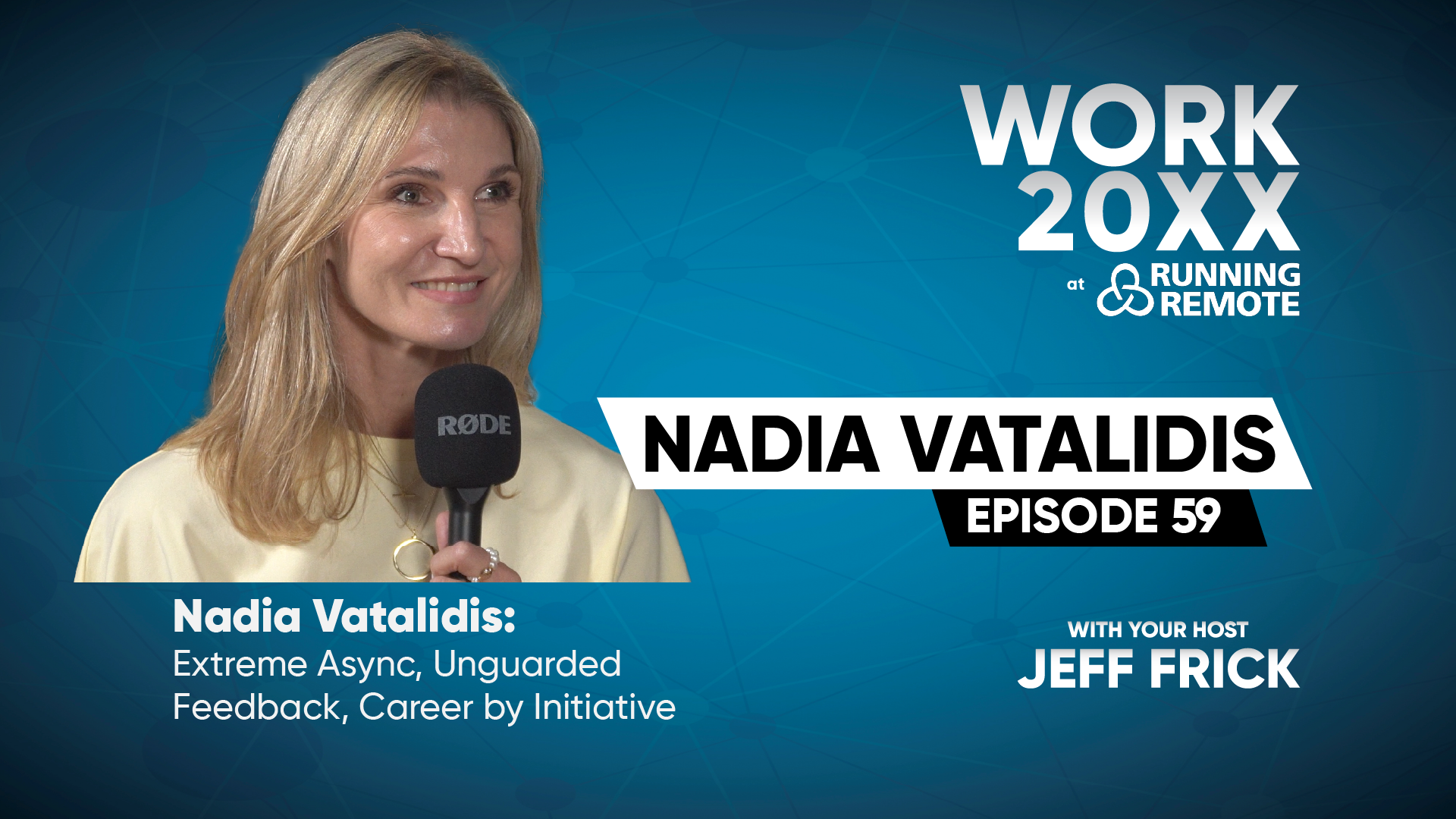
Nadia Vatalidis: Extreme Async, Unguarded Feedback, Career by Initiative | Work 20XX Ep59
Someone in our CX team is currently shadowing our brand design team and doing an epic job. She had a design qualification but no design experience. We're giving her that opportunity. Eventually she'll be able to join brand design team if we have a role available. But even if that person had to leave and become a brand designer that would be a huge win for her and for us. That we enabled her career her plan, her growth her goal, to get there. - Nadia Vatalidis
Nadia Vatalidis flew 10,000 miles, almost halfway around the world, to share her insights at Running Remote 2026 in Austin. And the distance is more than geographic. She doesn't live in the US, Europe or Asia. Her vantage is from South Africa, which povides a unique look 'back' if you will at the rest of the tech scene, with a differernt 'reality' check than I have here in Palo Alto, CA, in the eye of the storm, or even Asia or Europe or Austraila for that matter. Sometimes it's harder to tell what's happening when you're standing in the middle of it.
Nadia was there at the beginning. Over a decade ago, working alongside Darren Murph at GitLab in those early days, helping define what would become the blueprint, reference, dictionary, thesaurus and operations manual, the anchor document, for distributed work around the world, the 'GitLab Remote Work handbook, ' published open source, for the benefit of all. That kind of longitudinal perspective is rare, and she's added to it since, moving from GitLab through other fully remote companies to her current role as Head of People at Doist, 100% remote, 100+ people, 40+ countries.
So we got into the good stuff. Extreme async, functioning radical candor against 40+ cultures, and self managed careers. What does it take to create the conditions where honesty lands as a gift instead of a grenade, across so many different baseline cultural norms? Nadia explained their shadow program, giving people a chance to try before they buy in different types of roles, departments, and functions. And showing her care for the people, Nadia reinforced that even if that if helping someone grow means they eventually outgrow the company, that's not a failure. She celebrates the growth and development. That's the whole point. It gets celebrated. A great illustration and example of the mature, adult, professional, working demeanor required to operate in a world that prioritizes growth and improvement, at the risk of ruffling a few feathers (unintentionally).
And of course we got into how Nadia specifically and Doist generally are leveraging AI to deliver more with their existing team.
Good management is good management. These practices aren't just for remote or hybrid teams. They're for any leader who takes people seriously.
And if Nadia was willing to fly half way around the word to share, I can assure you it well worth your 25 minutes.
Please join me in welcoming Nadia Vatalidis to the Work 20XX Podcast.
Editor's Note: Recorded May 2026 at the Running Remote conference in Austin, Texas. Special thanks to Liam, Egor, Ana, and the entire Running Remote team.
Nadia Vatalidis: Extreme Async, Unguarded Feedback, Career by Initiative | Work 20XX Ep59 with Jeff Frick from Running Remote 2026
Episode Transcript
Nadia Vatalidis: Extreme Async, Unguarded Feedback, Career by Initiative | Work 20XX Ep59
English Transcript
© Copyright 2026 Menlo Creek Media, LLC, All Rights Reserved
--------------
### Cold Open
Okay, so we're ready to go in 3, 2, 1.
**Host (Jeff Frick):**
Hey, welcome back everybody. Jeff Frick here. Coming to you from Running Remote. We were here last year and we're excited to come back down to Austin. It's all things, that are all the leaders of running running remote and 100% remote companies. But the reason that we're here is good management is good management. As Darren Murph taught me so long ago. All remote companies force companies to be good at things that all companies should be good at starting with communication. And so we're excited to have somebody who's been in it for a while and continues to lead the charge. Welcoming in, she's Nadia Vatalidis the Head of People at Doist. Nadia, great to see you.
**Guest (Nadia Vatalidis):**
Nice to see you Jeff. I'm a little star struck.
**Host (Jeff Frick):**
Well, that's very nice of you to say, because you were there with Darren [Murph] and one might argue that Darren at least from the outside point of view and and GitLab was really one of the first to not only be fully remote, but more importantly document it in an open source way so that we could all learn.
**Guest (Nadia Vatalidis):**
Yeah, I loved working with Darren. We're still in touch. I love what he's doing right now. That was absolutely a magical journey and definitely a change in my career. And it literally also changed my life in working in this way.
**Host (Jeff Frick):**
Well I read a funny story that that you had your own thing going on in Johannesburg and your family said ‘What?’ You're going to stop your own thing to work for a company that has no offices. It's got to be fake.
**Guest (Nadia Vatalidis):**
Yeah, I think my parents I think my parents thought I would never get paid. I think they thought it was a complete scam. And a lot of my friends probably thought that I was actually a stay at home mom pretending to work. But yeah, I had a great four years at GitLab and love that they got to IPO as one of the first remote companies ever. And to do it in a in that open source fashion.
**Host (Jeff Frick):**
Right, right. But then you made an interesting comment on stage. You're just on a panel and you said Doist is even more async than any other company you've ever been around. I wonder if you can share? What is extreme async mean? Doist is really good at non meeting culture?
**Guest (Nadia Vatalidis):**
They've taken it to a point where it's slightly difficult to schedule meetings. And that means if we can solve problems asynchronously, we should. We really big on in-person connect time. So we have two off-sites a year or two on-sites, I don’t know what to call it these days but two retreats a year where we all get together. We currently in 42 countries or 40 countries, 100 people globally. And so we get together twice a year and the leadership team has a third has their one session. So that's a third connect with my peers. But the async version of that means we have excellent documentation. We dogfood our own tool called ‘Twist’ — Okay. Where we’re communicating daily. And they've really mastered the craft of communicating solving problems and I think the trust factor is probably the highest I have ever come across. And that makes the async aspect so easy.
**Host (Jeff Frick):**
It's really interesting because culture is so hard to build on remote companies and we hear people that aren't familiar with it complain you know how are we going to do it? And yet I came first heard about Doist from Chase [Warrington] because and learning about your guy’s events and the fact that that you don't save money on real estate that money is invested into events and these culture building things. What if you can share how special that is? Because you've been at other companies, but I don't know that anyone invests as much in the together time so that they build that connection so that they actually operate well when they're not together.
**Guest (Nadia Vatalidis):**
Yeah. Our together time is not only special, but the places we choose is very intentional. The time spent together. We absolutely have work time. This very intentional, meaningful problems being solved. But there's way more time to socialize and connect.
**Host (Jeff Frick):**
Right.
**Guest (Nadia Vatalidis):**
There's a lot organic spaces created specifically for that. And I think if you're spending that amount of money on the together time the way you choose the venue to really work for this kind of company these aren't average places, right? So.
**Host (Jeff Frick):**
Right.
**Guest (Nadia Vatalidis):**
Our recent stint was at a castle a chateau in France and it was absolutely this the second time Doist has been at a chateau. So Chase also has this unique ability to go and find these places to make it extra special. And he levels up every single time. So yeah, it's just been it's been magical. I will also say we because we have such an egalitarian structure the CEO's contributions is as important as an individual contributors contributions. And so he partakes even in performance review cycles himself and get that feedback. We have an accountability element for leadership where our leaders if we don’t make our annual reoccurring revenue benchmarks they cannot earn a rating above a specific level. So we measure out a four, right. So there's a lot of accountability elements that's been created intentionally to keep leaders accountable. And that builds a lot of trust with the rest of the organization, right. If you hold the right people accountable for their companies performance.
**Host (Jeff Frick):**
Right, right.
**Guest (Nadia Vatalidis):**
Yeah
**Host (Jeff Frick):**
I love that. The other things I learned from Chase, which which is kind of counterintuitive he said you know you would think when we got together we would spend most of that time on work because we're together, let's do work. But then he said, but then we realized we don't work that way. The whole company is designed not to work that way. And so I can't remember 30, 20% - 30% - 50%, but really flipped it on its head in terms of spending that time to build connection and trust not to sit in in a room looking at a whiteboard and operating in a way that you don't the other 360 days a year.
**Guest (Nadia Vatalidis):**
Yeah, absolutely. It's a lot of social time there's a lot of different there's a lot of different not just excursions, but also like meaningful ways to do things together.
**Host (Jeff Frick):**
Right.
**Guest (Nadia Vatalidis):**
In this recent retreat we had a bunch of folks that were learning how to make macaroons, right. Which was an utter disaster. But so fun. And there was another crew that did a what do they call it, like a scavenger hunt
**Host (Jeff Frick):**
Okay
**Guest (Nadia Vatalidis):**
around a castle. I mean I’m Yeah, that was so fun. And it was also an experiment to see who's going to win the scavenger hunt.
**Host (Jeff Frick):**
Right.
**Guest (Nadia Vatalidis):**
My team obviously won.
**Host (Jeff Frick):**
Or you wouldn't have brought it up, right?
**Guest (Nadia Vatalidis):**
Yeah. But it was. Yeah It's just a big to to see so many people commit to that. We don't make it compulsory, but it is something we care a great deal about.
**Host (Jeff Frick):**
Right
**Guest (Nadia Vatalidis):**
So we do ask every Doister to make that commitment. And if there's a timing or a year that they absolutely can't make it, that's okay. But we do want them to come to some of these.
**Host (Jeff Frick):**
Right, right.
**Guest (Nadia Vatalidis):**
So it's really important to us that everyone shows up. So it's equitable and it's fair for everyone to be traveling to be there.
**Host (Jeff Frick):**
That's great. Shifting gears a little bit you talked about radical candor in your keynote. And you guys are super transparent very much like GitLab everything is published. Everything is available to see. You also said you've got whatever 110 employees spread out over 40 countries. You know the cultural norms around candor can be very, very different. And I'm curious on kind of that specifically when you're trying to be so open and and give meaningful, constructive feedback. But all cultures don't accept or give feedback the same and some are much more candid. How do you manage that to keep everybody from pissing everybody else off?
**Guest (Nadia Vatalidis):**
Yeah. Great question. When I joined, Radical Candor was in our handbook and I don't think they understood what it meant at that time. It was just a statement. When we started developing the philosophy we decided knowing we have all these cultures, we need to be very intentional about what that means at Doist. And so we created the philosophy around radical candor and we wanted to make sure we were very clear about why we need to share very clear and direct feedback with each other but still keep the kindness factor of radical candor intact. And so it was genuinely just important to us that regardless of the cultural element we needed to build Doist culture in a way where people do feel safe to talk to each other about. And I think the more the more softening that happens the easier it is to confuse things. But I mean, books like Culture Map immediately comes to mind
**Host (Jeff Frick):**
Right
**Guest (Nadia Vatalidis):**
when I think about these things. So we this is an ongoing muscle we are building now. And I think it's I think it's still in its early stages and we're starting to get better and better at it.
**Guest (Nadia Vatalidis):**
Having developed the system and our, I mentioned Gemini coaches. Having an AI coach that helps soundboard some of that feedback. Keep in mind we built this with our company values and with our performance philosophy philosophy and our entire performance system in mind. So when your sound boarding feedback with a coach like that you are getting the radical candor back. The softening goes away and it gives you what you need. And so that also helps coach people to think through what they've shared. You can use that coach for example to put feedback in and ask does this make sense? Do I need to make changes. And it might give you feedback based on the philosophy or the values, etc.. Or, what did you miss, right?
**Host (Jeff Frick):**
Yeah. What's harder to to get the calm people up or to calm down the, the a little bit too radical candor-ous people?
**Guest (Nadia Vatalidis):**
Absolutely and culturally when you're German and you add radical candor I can imagine it's going to be very direct. I'm really joking, but I think we’ve found a healthy mix and it's going to be an ongoing journey. It's going to take it’s going to take time to build this skill internally.
**Host (Jeff Frick):**
Right.
**Guest (Nadia Vatalidis):**
And we're going to keep fine tuning it.
**Host (Jeff Frick):**
Right. Get better at it. So shifting gears a little bit about documentation. And again I learned from Darren way back when that documentation is the key. Do people trust the documentation? For a lot of bad meeting cultures. That's actually a big motivation because people are afraid they won't get the information if they're not at the meeting. You mentioned everything's open, including one on ones and including HR conversations with people. That might be a little difficult. Does that change people's reaction as more and more and stuff is recorded, is documented not to hold against them but for some reason and for follow on and to be able to feed in their performance review. Is that change the way the conversation goes do you think?
**Guest (Nadia Vatalidis):**
Yes. So one-on-one conversations are not open to anyone else than the two people having the one on one.
**Host (Jeff Frick):**
Cancel. Right.
**Guest (Nadia Vatalidis):**
So that is a safe space. However, that will be documented on the performance review. Right. Which the people team can of course access. But no, it's not shared publicly or in an open way.
**Host (Jeff Frick):**
Okay.
**Guest (Nadia Vatalidis):**
That part is only one-on-one. However, peer feedback is not anonymous, and I have always seen the argument between having peer feedback as entirely anonymous versus private. But I think we want to reach a maturity where we can be adults in the room. And with that in mind, we had to make peer feedback available to the person receiving the feedback. So that’s actually gone a really long way in terms of trust and starting to build that site safety that if I share this with you you're not going to get angry at me. And I think that's a self-awareness thing as well. We all need to continue to develop and grow.
**Host (Jeff Frick):**
Right.
**Guest (Nadia Vatalidis):**
And if people can see it with that intention of course not everyone will. But that's the point.
**Host (Jeff Frick):**
Right.
**Guest (Nadia Vatalidis):**
It's really the ultimate goal of this is to help people grow. If we keep that anonymous and private that can go awfully wrong. They're gonna think this just all comes from their manager or someone that that they don't trust or whatever the case may be.
**Host (Jeff Frick):**
Right.
**Guest (Nadia Vatalidis):**
So yeah, we've Yeah, we’ve gone on that journey.
**Host (Jeff Frick):**
Context is everything, right?
**Guest (Nadia Vatalidis):**
Yeah.
**Host (Jeff Frick):**
So the other part I thought that was interesting in your talk that you just had is you said you know on your performance philosophy who is responsible for the individual's career growth. And I thought it was really insightful. Most people think it's the boss, but you're like, no, it's not the boss. You're responsible for your own career growth. But at the same time I'm you know, the challenge of having a relatively small company, which you said a number of times is relatively flat, so how do people navigate career growth? You also said you had a bunch of people that just celebrated ten years. So how do people navigate their careers inside a relatively small flat organization that continue to grow and develop and and move up up the line even if it's not necessarily by title or by role?
**Guest (Nadia Vatalidis):**
So our individual contributors can outgrow our Heads and Leads in level, because the way we built the framework is the IC career goes all the way up to nine which is the same level as a Head. That does not include our CXO team. We only have three CXO members so that's the only team above that. That means a IC 9 can report into a Head 6 or Head 7. And so we're not preventing them from growing. And they will get paid the same as a Head 9 or a Lead 9 at that level.
**Host (Jeff Frick):**
So it’s their level not necessarily their role or their function. You've split level out from role and function.
**Guest (Nadia Vatalidis):**
We haven't. So no.
**Host (Jeff Frick):**
Oh you haven't. Okay.
**Guest (Nadia Vatalidis):**
So level and role goes hand in hand.
**Host (Jeff Frick):**
Okay.
**Guest (Nadia Vatalidis):**
If you're a software engineer we're not going to change your job title. But you can be a software engineer let's say a front end engineer that is IC-7 or IC-8 or IC-9. There's a different impact expectation and deliverables description based on that level. So if you're currently a front end engineer IC let's say 4 and you want to become an IC-5 front end engineer you start looking at what does it take to deliver at IC-5 level. Do I even want to do that? Can I do that, right? And start operating at that level and work towards those goals. If you can have that impact that promotion journey is probably yours.
So it's really about starting to think about what is next for you. What do you want to do next? If you want the leadership path we need to look at at a company of 100 people how many lead roles do we have? So those opportunities are rare. But as individual contributors you can really outgrow us. I think that's the one part.
The other part is if you want to do a shadow program with a different team it's up to you to start that conversation. And your boss can't prevent you from doing a shadowing journey with another team. We have a very interesting scenario where someone in our CX team is currently shadowing our brand design team and doing an epic job. She had a design qualification but no design experience. We're giving her that opportunity to shadow our brand design team for three it's now actually six months and eventually either she'll be able to join hopefully if we have a role available brand design team. But even if that person had to leave and become a brand designer that would be a huge win for her and for us.
**Host (Jeff Frick):**
Right.
**Guest (Nadia Vatalidis):**
That we enabled her career her plan, her growth her goal, to get there. So yeah, there's a lot of individual autonomy, but you have to be willing to take those steps to make them happen.
**Host (Jeff Frick):**
Curious for the shadow thing. Is it just a temporary assignment? Do you still have your regular job? Is it some percentage of your time that you dedicate to that? Or are you like the little intern that they bring into things or are they giving you a little projects? How does that work? That's pretty cool to have a second job in your job.
**Guest (Nadia Vatalidis):**
Yeah. It's not a second job. So we absolutely don't expect them to operate 100% at both. This is something they could do as a side gig while employed We can make arrangements for them to reduce their current metrics, etc. With this particular example she was able to pull it off because she leaned into automation with some of her CX work. So she was really smart in what is the work that is literally. Touching my soul negatively that I don't want to do any longer? And how can I pivot towards design more and more? And so by automating some of her day to day CX work she was able to take on more design work. So it was a very, very smart, very unique scenario. But usually we would say it's like an 80/20 split. You can shadow for 20%. you can do your job for 80%. We have another example in CX that someone has moved to our brand dev, branded engineering team fully and 100% also through a small shadow experience, but they also put their hand up for very tough problems. So if the CX team while they were in CX was struggling with engineering or was struggling with a data issue or a tool issue, they would solve it they would solve it and keep gaining that engineering access and experience and eventually moved over fully So yeah, we're not going to add 100% pressure on both ends but we usually work that out. I think we're also we have the the lack of the size right to make things like that happen.
**Host (Jeff Frick):**
Right.
**Guest (Nadia Vatalidis):**
We're now working on fine fine tuning that shadow program and making it a lot more company wide accessible so people know how how to go about it. As I said, it's very it's your career.
**Host (Jeff Frick):**
Right.
**Guest (Nadia Vatalidis):**
You need to take that first step. We now also want to help people understand what that could look like.
**Host (Jeff Frick):**
Do you see it almost as a prerequisite down the line? Is it almost kind of it's an internal transfer process that’s masquerading as a as a shadow process as a shadow process where people can explore different parts of the company that maybe within their career growth they want to go, but they're not sure. I've never done this. So you know it's kind of a good way to get exposure to other parts of the company.
**Guest (Nadia Vatalidis):**
Yeah, I also think you might do it and you might hate it.
**Host (Jeff Frick):**
Right.
**Guest (Nadia Vatalidis):**
Right, so it's this awesome safe opportunity. We're not going to take your current job away from you to just experiment and explore. And it might not actually be something you want to do.
**Host (Jeff Frick):**
Yeah.
**Guest (Nadia Vatalidis):**
So yeah, I think it's just helping. It's giving someone the best possible experience while they're still working with us to go and chase those goals like experiment.
**Host (Jeff Frick):**
it's great.
**Guest (Nadia Vatalidis):**
Yeah.
**Host (Jeff Frick):**
I love it. Okay, so you're a self prescribed tech nerd. You told us on stage. And you've also been playing and building little bits of code and playing with GenAI so I wonder if you can share you know, kind of your personal journey discovering these tools because I think you also said you're not a coder by trade. So let's start there. And then how you're seeing and driving adoption within the organization to get people to, to use these new things.
**Guest (Nadia Vatalidis):**
Yeah. All thanks to GitLab in 2016 for making me use a terminal and dog fooding the product. So I will say I had that as an intro which made a huge difference. I did take GitLab’s Handbook down in 2016, I think December by removing an image. So I made mistakes.
**Host (Jeff Frick):**
By accident.
**Guest (Nadia Vatalidis):**
By accident. I took the whole handbook down.
**Host (Jeff Frick):**
Destroyed the entire world's remote culture. Everyone is on that GitLab handbook.
**Guest (Nadia Vatalidis):**
But I loved how people reacted. So the first thing they did was celebrate. They were like like clap and okay, how did you do that? And so I loved that it wasn’t like What the heck, Nadia?
**Host (Jeff Frick):**
Like, how did you break it? How dare you like what
**Guest (Nadia Vatalidis):**
Yeah
**Host (Jeff Frick):**
Like what did you expose in your process? What did you do? What did you do to break this? And then not fixing it for me? I think that was that first time where I was like, Oh, I need to fix this myself. And they will guide me but they're not doing it for me. So that was that first touchpoint of experimenting my GitLab like little tick blocks. You get this journey right that looks similar to GetHub and the others that follows your journey on whereas some of them had like 75 merge requests a day. So I was busy from a from that perspective. But yeah, I think it was just install a terminal like experimenting get stuck, figure it out, ask Gemini to figure it out ask Claude to figure it out with you That's the part a lot of people are afraid of. And actually a lot of these tools can help you solve where you get stuck. And yeah, so getting back into it is actually made me a lot braver in this current age and stage and a lot of the things we’re building now in our public handbook Andrew and I created from scratch We had some help from engineering. We do get stuck. We're not afraid to ask for help. We do break things, but it's taught us so much. And every time something does break or every time we run into an issue, it's further learning. So I do feel like my my brain space is just developing in a whole different area now where I can do harder things that I simply wouldn't have done before as the Head of People at a local tech company.
**Guest (Nadia Vatalidis):**
Yeah. So it's been experimenting. Really.
**Host (Jeff Frick):**
What's been the biggest the biggest challenge with your teams? So the curious people that love to experiment you know they're not hard there in there, you probably have to gate them a little bit and reign them in a little bit. For the folks that aren't so natural curious? Or maybe you've maybe they're just not part of your culture? How do you help the ones that are just not quite ready? I need a little bit of a push.
**Guest (Nadia Vatalidis):**
Yeah. We at our team connect in France. We ran a little work session and this is the part that I love. We had a finance person host how to install Claude Code on a terminal onto everyone's machines. It wasn't an engineer, it was a finance person speaking normal non engineering language and it made a huge difference. So Meg from our team actually hosted that session and I saw non engineers. I just saw lights going on of like Oh, this isn’t, yeah
**Host (Jeff Frick):**
If he can do it, right.
**Guest (Nadia Vatalidis):**
So I think it's that. Getting non engineers to to also shadow other non engineers that has gone down that path. Cause once you start using language like merge request, pull request, terminal, markdown Whatever the case people really look at you like ‘Oh’ this is so scary. And it isn’t But having a non engineer explain it they're going to use language that you and I are going to use daily, right.
**Host (Jeff Frick):**
Right.
**Guest (Nadia Vatalidis):**
And so yeah that was a real win. I also think leadership that fails at things helps. So I've had a few fails. I mean Amir has broken things.
**Host (Jeff Frick):**
Not just breaking but breaking in public, right?
**Guest (Nadia Vatalidis):**
Yes
**Host (Jeff Frick):**
And sharing that
**Guest (Nadia Vatalidis):**
Yeah
**Host (Jeff Frick):**
I broke it.
**Guest (Nadia Vatalidis):**
You know
**Host (Jeff Frick):**
Yeah
**Guest (Nadia Vatalidis):**
Now we have to fix it but
**Host (Jeff Frick):**
Yeah, and then making that effort, right. And not panicking, I think that really helps with that that sort of fear of starting.
**Host (Jeff Frick):**
Right.
**Guest (Nadia Vatalidis):**
Yeah.
**Host (Jeff Frick):**
All right Nadia. So we're getting to the end of our time. Last question. You probably win the award for coming the furthest to Running Remote. I don't know that for a fact but I would be willing to put some money down. You're in Johannesburg, South Africa. I'm Palo Alto living in this crazy bubble in this tech world and you've been remote for ten years. I'm just curious to get your perspective from kind of the real world different hemisphere different season as you look at it from your seat and kind of where are we in the adoption within people that you're hiring every day. Give us a little reality check on where we are and what you're excited about.
**Guest (Nadia Vatalidis):**
I mean I'm so privileged and lucky and grateful to be working in tech from South Africa. I know that's rare. I see a lot of roles like mine saying Head of People remote, US. Head of People remote, UK. So one, I'm so grateful to have that. I hope that can stay in future. As we transition into the AI stage. There's a lot of great talent in Africa like keep looking, for those people. I think developing countries are behind. I'm a little worried about the things they're behind in. So where we have experimented with automation integration. Those countries have not started that yet, and they're trying to skip that basic automation step by fixing it with AI, which is really expensive. So I think one, a lot of developing countries probably need to start building those foundations with good automation and integration first and then build AI on top of that. We can learn so much from events like these people that follow you. Yeah, I feel like it’s an interesting intersection but I think it's also a very scary time. And so making more things available open sourcing more opportunities for folks to access how, and where to start.
**Host (Jeff Frick):**
Right.
**Guest (Nadia Vatalidis):**
Yeah
**Host (Jeff Frick):**
I think the open source component is so amazing and such an important piece of this whole journey because there is resources. You just got to do a little work. But you know, you guys publish everything, GitLab publishes everything. There's a lot of information out there.
**Guest (Nadia Vatalidis):**
Yeah. Yeah, our public handbook is only a year old. So I started it and it's very scrappy, but it worked. People love it. They're asking us the right questions. Candidates love it. They have access to see how they'll be reviewed. So yeah, it's fun to be on this journey. And as long as we inspire one other small company to start something or one person to start something, then job done, right. Yeah.
**Host (Jeff Frick):**
Right. That’s a win Well, Nadia, so great to finally meet you in person after seeing you online for all these years. So I'm, so glad you're making it. I didn't travel this far. So you get the credit for the travel.
**Guest (Nadia Vatalidis):**
Yeah. Great to meet you Jeff, it’s been years Yeah. So lucky to have ran into you here.
**Host (Jeff Frick):**
Yes, absolutely. All right. She's Nadia, I’m Jeff. We’re at Running Remote in Austin. Thanks for watching. Thanks for listening on the podcast. See you next time. Take care. Bye bye.
---
Cold Close
Yay! Awesome.
Joy, thanks so much.
Awesome.
It was fun.
---
Nadia Vatalidis: Extreme Async, Unguarded Feedback, Career by Initiative | Work 20XX Ep59
English Transcript
© Copyright 2026 Menlo Creek Media, LLC, All Rights Reserved
LINKS & REFERENCES
Nadia Vatalidis: Extreme Async, Unguarded Feedback, Career by Initiative | Work 20XX Ep59
━━━━━━━━━━━━━━━━━━━━━━━━━━━━━━━━━━━━━━━━
NADIA VATALIDIS — APPEARANCES & PROFILES
━━━━━━━━━━━━━━━━━━━━━━━━━━━━━━━━━━━━━━━━
Jan 2026 · The Strategic Playbook for Building a Remote-First Company
Future of Work Podcast / Allwork.Space · Frank Cottle, host
Global hiring, compensation equity, time zone productivity, remote-first as mindset.
https://allwork.space/2025/12/the-strategic-playbook-for-building-a-remote-first-company-with-nadia-vatalidis/
Aug 2025 · Why and How to Take a Remote-First Approach to Hybrid Work
The People Space · Siân Harrington, host
"Remote forced vs. remote first" — Nadia's take on why most hybrid models miss the point.
https://www.thepeoplespace.com/insights/leaders/chro-nadia-vatalidis-why-and-how-take-remote-first-approach-hybrid-work
Jul 2025 · Scale People, Connection, and Culture in Remote-First Companies
Collaboration Superpowers Podcast · Head of Remote Series
Behind the scenes of scaling from 70 to 1,000+ employees. Intentional connection in distributed orgs.
https://www.collaborationsuperpowers.com/350-scale-people-connection-and-culture-in-remote-first-companies-with-nadia-vatalidis/
2025 · Flexibility Will Help Build a Better World of Work
People Managing People · Interview
Remote work flexibility, global talent, and what HR leaders get wrong about distributed teams.
https://peoplemanagingpeople.com/articles/build-better-interview-nadia-vatalidis/
2025 · Building a Self-Enabled Culture
Reimagining Company Culture Podcast · AllVoices
Onboarding in remote-first environments and creating culture where people are set up to succeed.
https://www.allvoices.co/podcast/self-enabled-culture-nadia-vitalidis
2024 · Interviewing, Storytelling, and Employer Brand (two episodes)
Relancer Podcast · Eero Veider, host
Structured interviewing, employer brand alignment, attracting the right talent through authentic storytelling.
https://podcasts.apple.com/us/podcast/relancer-podcast/id1731831737
2022 · Supporting Employees Through Hyper Growth
ChartHop Q&A
How Nadia grew Remote.com from 50 to 600+ employees in under a year.
https://www.charthop.com/resources/nadia-vatalidis-supporting-hypergrowth
2021 · A Self-Enabled Culture with Nadia Vatalidis (video)
YouTube · AllVoices
Onboarding, culture-building, and psychological safety in distributed teams.
https://www.youtube.com/watch?v=_jCNgqwUdlM
Nadia Vatalidis — Author Archive at Remote.com
Written guides on neurodivergence, LGBTQ+ inclusion, international hiring, async operations.
https://remote.com/resources/insights-center/author/nadia-vatalidis
Nadia Vatalidis on LinkedIn (34,000+ followers · Johannesburg, South Africa)
https://www.linkedin.com/in/nadiavatalidis/
━━━━━━━━━━━━━━━━━━━━━━━━━━━━━━━━━━━━━━━━
DOIST — COMPANY & TOOLS
━━━━━━━━━━━━━━━━━━━━━━━━━━━━━━━━━━━━━━━━
How Doist Works Remote
95% async communication, Twist as operating backbone, why real-time defaults fail.
https://doist.com/how-we-work/how-doist-works-remote
Aug 2025 · How Amir Salihefendić Scaled Doist with Asynchronous Work
Business of Software · Founder's philosophy on async as a company-wide operating model.
Bootstrapped, 120+ people, 30 countries, no outside investment.
https://businessofsoftware.org/2025/08/how-amir-salihefendic-scaled-doist-with-asynchronous-work/
2022 · How Writing Helps Doist's Async Setup Soar
Slab / Knock Down Silos
How Doist consolidated fragmented docs into a public GitHub handbook — following the GitLab model.
https://slab.com/blog/how-writing-helps-doists-asynchronous-setup-soar/
2021 · Doist Redesigns Twist, the Slack Alternative Focused on Async Work
TechCrunch
The tool Nadia references as Doist's daily communication backbone — threads-first, calm by design.
https://techcrunch.com/2021/10/12/doist-redesigns-twist-the-slack-alternative-focused-on-async-work/
Twist — Async Team Communication (Doist's product)
https://twist.com/
The Art of Async: The Remote Guide to Team Communication
Doist's public guide — transparency, searchability, 95% non-real-time.
https://twist.com/remote-work-guides/remote-team-communication
━━━━━━━━━━━━━━━━━━━━━━━━━━━━━━━━━━━━━━━━
GITLAB & DARREN MURPH — REFERENCED IN INTERVIEW
━━━━━━━━━━━━━━━━━━━━━━━━━━━━━━━━━━━━━━━━
2021 · GitLab Remote Work Playbook
Darren Murph · The open-source blueprint Nadia credits as formative.
30+ guides covering async, meetings, hiring, compensation, L&D — all public.
https://about.gitlab.com/press/releases/2021-04-20-all-remote-playbook/
2020 · What People Tend to Get Wrong About Remote Work
TechCrunch · Darren Murph interview
Why most companies copy-paste office behavior into remote environments and fail.
https://techcrunch.com/2020/05/20/what-people-tend-to-get-wrong-about-remote-work/
2019 · Why We Believe All-Remote Is for Everyone
GitLab Blog · Darren Murph
Murph's founding piece — 800+ people, 57 countries, no central office required.
https://about.gitlab.com/blog/all-remote-is-for-everyone/
━━━━━━━━━━━━━━━━━━━━━━━━━━━━━━━━━━━━━━━━
BOOKS & FRAMEWORKS REFERENCED
━━━━━━━━━━━━━━━━━━━━━━━━━━━━━━━━━━━━━━━━
The Culture Map: Breaking Through the Invisible Boundaries of Global Business
Erin Meyer · INSEAD Professor · Published 2014
Referenced by Nadia on cross-cultural feedback norms across 42 countries.
Meyer's 8-scale framework maps how cultures differ on feedback directness,
trust, decision-making, and communication style.
https://erinmeyer.com/books/the-culture-map/
━━━━━━━━━━━━━━━━━━━━━━━━━━━━━━━━━━━━━━━━
RUNNING REMOTE — EVENT CONTEXT
━━━━━━━━━━━━━━━━━━━━━━━━━━━━━━━━━━━━━━━━
Running Remote Conference · Austin, TX
Annual conference for leaders of 100% remote companies. Where this interview was recorded.
https://runningremote.com
May 2024 · Chase Warrington: Priorities, Abroad, Async, Retreats | Work 20XX Ep26 · 52 min
Head of Remote at Doist — the episode that introduced Jeff to the Doist world.
Chase is referenced twice in this interview: for the introduction, and for his gift
finding extraordinary retreat venues (châteaux in France, twice).
https://www.work20xx.com/episode/chase-warrington-priorities-abroad-async-retreats-work-20xx-ep26
━━━━━━━━━━━━━━━━━━━━━━━━━━━━━━━━━━━━━━━━
RELATED WORK 20XX EPISODES
━━━━━━━━━━━━━━━━━━━━━━━━━━━━━━━━━━━━━━━━
May 2026 · Liam Martin v2: Distributed Intelligence, AI-Native Organizations | Work Ep58
https://www.work20xx.com/episode/liam-martin-v2-distributed-intelligence-ai-native-organizations-work-20xx-ep58
Aug 2025 · Liam Martin: Community Retreat, Remote, AI | Work Ep55
https://www.work20xx.com/episode/liam-martin-community-retreat-remote-ai-work-20xx-ep55
Aug 2024 · Brian Elliott v2: AI, Experiment, Outcomes, Trust | Work Ep28
https://www.work20xx.com/episode/brian-elliott-v2-ai-experiment-outcomes-trust-work-20xx-ep28
May 2024 - Chase Warrington, Priorities Abroad Async Retreats, Work 20XX, Episode 26
https://www.work20xx.com/episode/chase-warrington-priorities-abroad-async-retreats-work-20xx-ep26
Feb 2024 · Dominic Price: Experiment, Feel, Safety, Learning | Work 20XX Ep23
https://www.work20xx.com/episode/dominic-price-experiment-feel-safety-learning-work-20xx-ep23
Dec 2021 · Darren Murph: Remote First, Async, Communications Operating Manual | Work 20XX Ep01
https://www.work20xx.com/episode/episode-1-darren-murph
━━━━━━━━━━━━━━━━━━━━━━━━━━━━━━━━━━━━━━━━
Work 20XX with Jeff Frick · Work20xx.com · Menlo Creek Media


Jeff Frick has helped literally tens of thousands of executives share their stories. In his latest show, Work 20XX, Jeff is sharpening the focus on the future of work, and all that it entails.